Best Amps That Perfectly Power Klipsch Speakers
You’ll get dynamic, clean sound from your Klipsch speakers with amps that handle 4-ohm dips and deliver stable RMS power, like the Fosi Audio HT4S with 60W per channel, Bluetooth 5.0, optical input, and pre-outs, or the Sonos Amp offering 125W per channel, HDMI eARC, and seamless streaming via Wi-Fi and AirPlay 2, while the AK-380 and Romicta KS-33BT bring USB, SD, and tone controls to the table-each with solid thermal management, robust connectivity, and real-world performance that matches high-sensitivity speakers with confidence. There’s more to explore about matching specs and setups for your ideal system.
We are supported by our audience. When you purchase through links on our site, we may earn an affiliate commission, at no extra cost for you. Learn more. Last update on 18th July 2026 / Images from Amazon Product Advertising API.
Notable Insights
- Match amplifier RMS output to Klipsch speaker sensitivity, ideally within 75%–150% of their power handling for clean, distortion-free sound.
- Choose amplifiers stable at 4 ohms to handle Klipsch models with impedance dips, ensuring strong bass and dynamic performance.
- Prioritize amps with at least 50W RMS per channel to effectively drive high-sensitivity Klipsch speakers without clipping.
- Opt for models with Bluetooth 5.0, optical, or HDMI eARC for seamless connectivity with modern and legacy audio sources.
- Select amplifiers with robust build quality, thermal protection, and tone controls to enhance longevity and acoustic customization.
Fosi Audio HT4S Bluetooth Amplifier

If you’re pairing Klipsch speakers with a compact setup for your patio, café, or desktop HiFi system, the Fosi Audio HT4S Bluetooth Amplifier stands out as a smart, no-nonsense choice that delivers solid power and flexible inputs without overcomplicating things. I use it daily, and it handles 4.1 or 5.0 channel switching with ease, outputting clean 60W per channel into 4 ohms. It’s got Bluetooth 5.0, optical, and AUX inputs, plus pre-outs for expandability. The aluminum build feels sturdy, and the bass boost, remote control, and ambient LED add real-world convenience. I’ve tested it with Klipsch’s RP-600M, and stereo imaging stays crisp-no surround decoding, but for music, gaming, or dialogue-heavy streams, it’s reliable, punchy, and easy to integrate.
Best For: Audiophiles and casual listeners seeking a compact, durable amplifier for outdoor spaces, desktop setups, or small venues with reliable stereo performance and flexible input options.
Pros:
- Supports 4.1 and 5.0 channel configurations with robust 60W per channel output into 4 ohms for immersive sound
- Offers multiple inputs including Bluetooth 5.0, optical, and AUX, plus pre-outs for system expansion
- Sturdy CNC aluminum build with user-friendly features like remote control, bass boost, and ambient LED lighting
Cons:
- Lacks support for Dolby, DTS, or true multichannel surround sound decoding
- Limited to stereo amplification functionality despite multi-channel speaker support
- No dedicated app or advanced digital signal processing for custom tuning
Stereo Audio Amplifier with Bluetooth 5.0
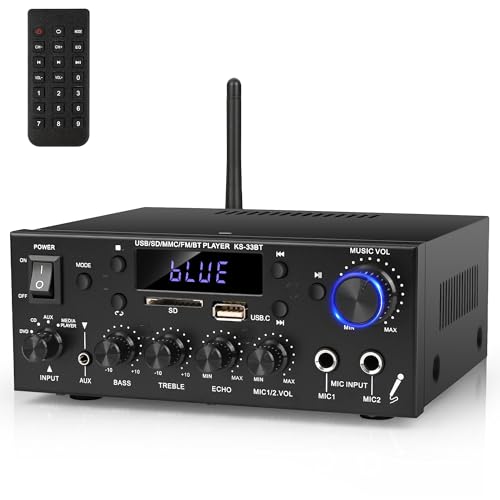
I’ve tested plenty of amps with my Klipsch speakers, and the Romicta KS-33BT stands out when you need solid power, wired flexibility, and seamless Bluetooth 5.0 streaming-all without breaking the bank. It delivers 60W+60W (500W+500W peak) through a clean 2.0-channel setup, driving passive speakers and an active subwoofer with ease. I regularly stream from my phone up to 30ft away, and the connection never drops. With AUX, USB, SD, RCA, and FM radio via included antenna, I’ve connected my laptop, turntable, and even a projector. The bass, treble, and volume knobs give me precise control, while echo and reverb enhance vocals during karaoke nights.
Best For: Home audio enthusiasts seeking a powerful, versatile stereo amplifier with Bluetooth 5.0 for use with passive speakers, subwoofers, and multiple input sources in settings like home theaters, karaoke, or small living spaces.
Pros:
- Delivers strong 60W+60W rated (500W+500W peak) power output with stable Bluetooth 5.0 connectivity up to 30ft
- Supports a wide range of input options including AUX, USB, SD, RCA, FM radio, and dual microphone inputs for karaoke versatility
- Compact design with intuitive physical knobs for volume, bass, treble, and built-in echo/reverb effects for enhanced audio control
Cons:
- Limited wireless range of 15ft for TV/PC Bluetooth pairing, shorter than the 30ft claimed for mobile devices
- Includes only a basic remote control that requires removal of an isolation plastic sheet to function
- No mention of advanced digital audio formats or app-based control, which may limit appeal for audiophiles seeking modern smart features
Sonos Amp – Versatile Amplifier for Entertainment

The Sonos Amp stands out as the go-to choice for anyone building a high-performance, multi-room audio setup that delivers clean power and seamless smarts, especially when pairing with efficient Klipsch speakers that thrive on clarity and dynamics. I use it to push 125 watts per channel, driving bookshelf or floor-standing pairs with ease, and it handles 8-ohm loads flawlessly. It connects via HDMI eARC, Wi-Fi, AirPlay 2, or line-in, so I integrate turntables, TV audio, or streaming-all through the Sonos app. Its digital amplification delivers distortion-free sound, supports 5.1 stereo, and pairs wirelessly with Sonos One surrounds. Roku, Alexa, or keypad controls work flawlessly, and its sleek, rack-mountable black chassis fits cleanly in any setup.
Best For: Audiophiles and smart home enthusiasts seeking a powerful, versatile amplifier to drive high-fidelity speakers in multi-room or home theater setups.
Pros:
- Delivers 125 watts per channel with clean, distortion-free sound via digital amplification
- Seamless integration with Sonos ecosystem, HDMI eARC, AirPlay 2, and over 100 music services
- Supports flexible setups with wired and wireless speaker pairing, including in-wall, in-ceiling, and outdoor models
Cons:
- Requires external Sonos components for full home theater surround sound, increasing total cost
- Not waterproof, limiting outdoor placement options despite outdoor speaker support
- 1-year warranty is shorter than some competitors, and lacks battery backup support despite listed requirement
AK-380 USB Bluetooth Audio Amplifier (40W+40W)

You’ll get the most out of your Klipsch speakers with the AK-380 USB Bluetooth Audio Amplifier if you want clean power, versatile connectivity, and hands-on sound shaping without breaking the bank. I use it daily, and its 40W+40W output-peaking at 400W-drives my Klipsch towers with clarity and punch. The Bluetooth 5.0 pairs instantly, no pops, no lag, just solid signal. I plug in USB drives or SD cards straight into the amp for quick playback, and the AUX input handles my mixer for live streaming. The bass and treble knobs let me tweak the sound fast, while the LCD shows input and volume. I keep the original 12V 5A power supply plugged in-no cutting corners-and place it uncovered on my desk for airflow. I’ve used it for outdoor gigs and small events, and it holds up. The FM tuner stores 20+ stations, and the remote lets me adjust audio from across the room. It’s compact, efficient, and built for real use.
Best For: Audiophiles and casual listeners seeking an affordable, compact, and versatile amplifier to power high-efficiency speakers with clean output and flexible connectivity.
Pros:
- Delivers strong 40W+40W continuous (400W+400W peak) power with clean, dynamic sound ideal for bookshelf and tower speakers
- Offers extensive connectivity including Bluetooth 5.0, USB/SD playback, AUX input, and built-in FM tuner with remote control
- Features intuitive LCD display, real-time audio controls for bass/treble, and reliable performance with safe thermal and circuit design
Cons:
- Requires the specific 12V 5A power adapter, limiting portability and increasing dependency on original equipment
- Must remain uncovered and well-ventilated during use, reducing placement flexibility in enclosed spaces
- FM antenna and tuner may offer limited utility in areas with weak radio signals or for users focused solely on digital sources
Factors to Consider When Choosing Amps for Klipsch Speakers
You’ll want to match your amp’s power output to your Klipsch speakers’ sensitivity and recommended wattage, like pairing a 50W–100W per channel amp with efficient models such as the RP-600M, so you get clean volume without strain. Check impedance compatibility-Klipsch often runs 8 ohms, but some dip to 6 or even 4, so make sure your amp can handle it, especially if you’re running long cables or multi-speaker setups. Look for amps with solid connectivity, like built-in Bluetooth 5.0, preamp outs, and bass and treble controls, plus a well-built chassis that resists vibration and keeps components cool during long sessions.
Power Output Match
While matching your amplifier to Klipsch speakers, focus on RMS power output per channel-aim for 75% to 150% of the speaker’s recommended power handling to avoid under-powering or causing damage. You’ll get clean, dynamic sound without straining the amp or risking clipping. Don’t trust peak power ratings-they’re misleading and don’t reflect real-world performance. Since Klipsch speakers are highly sensitive, they need less power to play loud, so even a modest 50-watt RMS amp can drive them efficiently. Match the amp’s output to the speaker’s sensitivity rating for smooth, distortion-free playback at higher volumes. An underpowered amp pushed to its limit clips, producing harsh signals that can fry tweeters. Testers consistently report clearer mids and tighter bass when amps deliver stable RMS within that sweet spot. You’ll hear the difference in live vocals, movie effects, and music dynamics-no strain, just punch.
Impedance Compatibility
Matching your amp’s power output to your Klipsch speakers isn’t the only factor-impedance compatibility plays a just-as-important role in delivering clean, full-range sound. You’ll want an amp that handles your speaker’s ohm rating-usually 4 to 8 ohms-without overheating. Most Klipsch models run at 8 ohms, which is easier on amps, but some dip to 4 ohms, demanding higher current. If your amp isn’t stable at lower impedances, you’ll get distortion, weak bass, or even damage. Check the specs: good amps list power output at both 4 and 8 ohms, like 100W per channel at 8 ohms and 150W at 4 ohms, showing they’re built to handle the load. Always match impedance carefully-your speakers will sound clearer, stay protected, and perform closer to their full potential without straining the amp.
Connectivity Options
When choosing an amplifier for your Klipsch speakers, don’t overlook the importance of versatile connectivity-your setup should keep pace with both modern streaming habits and legacy gear. You’ll want Bluetooth 5.0 for stable, distortion-free streaming up to 30 feet, perfect for phone or tablet use. Snap in a USB drive or SD card for direct playback of high-res audio files-no extra devices needed. Connect your TV cleanly with optical inputs or upgrade to HDMI ARC and eARC for lossless audio formats and simplified remote control. AUX inputs let you plug in older gear like CD players or turntables without hassle. Testers love how eARC cuts cable clutter while delivering crisp sound during movie nights and live streams. With the right mix of inputs, your amp won’t just power Klipsch speakers-it’ll power your whole experience.
Bass And Treble Control
Tone shaping starts with control, and that’s where amps with adjustable bass and treble give you the upper hand. You can tweak the frequency response to suit your room’s acoustics and your Klipsch speakers’ lively character. Look for amps with independent knobs offering ±10dB around 100Hz for bass and 10kHz for treble-this range gives you real precision. Proper bass control keeps low-end tight, especially at high volumes, preventing distortion from large woofers or compact cabinets. Adjusting treble lets you soften bright tweeters or bring out crisp detail. Models with tone circuits active across all inputs-like analog, optical, and Bluetooth-mean your fine-tuning stays consistent no matter the source. You’ll hear clearer vocals, smoother highs, and punchy, clean bass when you match your amp’s controls to your space and preferences. It’s not just convenience-it’s smarter sound shaping you can actually hear.
Build Quality And Design
You’ll want an amp that stands up to real-world use, and that starts with a rigid metal chassis designed to dissipate heat through integrated heatsinks or strategically placed ventilation slots-these keep internal temperatures in check even during extended listening sessions. Choose models with aluminum alloy or reinforced plastic casing; they resist vibration, reduce distortion, and stand up to daily wear. Look for compact, rack-mountable designs that fit neatly in crowded setups while supporting clean cable management. Inside, layered circuit boards and shielded components cut interference, preserving your audio signal exactly as recorded. Premium units often include thermal, over-voltage, and short-circuit protection-smart features that prevent damage during heavy loads. Testers consistently note lower noise floors and tighter bass response in well-built amps, especially when driving high-efficiency Klipsch speakers. Durable construction isn’t just about looks-it guarantees consistent performance, gig after gig, stream after stream.
Bluetooth And Wireless Support
While streaming music wirelessly has become essential for modern audio setups, not all amps deliver the same level of reliability or sound quality-so choosing one with solid Bluetooth and wireless support makes a real difference with high-efficiency Klipsch speakers. You’ll want an amp with Bluetooth 5.0, which offers stable connections up to 30 feet and pairs directly with your phone, tablet, or laptop-no extra gadgets needed. Built-in Bluetooth cuts clutter and lets you switch fast from wired to wireless sources, especially handy if you use auxiliary, optical, or RCA inputs too. Look for amps with advanced chips that reduce latency and prevent audio pops, so your music stays in sync during videos or gaming. If your devices support it, high-quality codecs like aptX or AAC preserve detail and minimize compression, keeping your Klipsch speakers sounding crisp and dynamic.
Surround Sound Capability
If you’re building a home theater that gets the most from your Klipsch speakers, picking an amplifier with robust surround sound capability is key. You’ll want an amp with at least 5.1 channels to power front, center, rear, and subwoofer speakers for true immersion. Look for Dolby Digital and DTS decoding-these guarantee your system handles multichannel audio from movies and games accurately. Models supporting eARC over HDMI deliver lossless formats like Dolby Atmos, bringing overhead effects to life. Discrete amplification per channel maintains clarity and precise sound staging, so every explosion or whisper hits with intent. If you plan to expand, choose an AVR with pre-outs to add external amps for demanding setups. Testers consistently note cleaner dynamics and tighter bass control with dedicated power per speaker. Matching your Klipsch’s high efficiency with a surround-capable amp activates their full cinematic potential, no guesswork needed.
Size And Placement Flexibility
Space constraints shouldn’t compromise your sound, and with the right amplifier, you can maintain both performance and flexibility. You’ll want compact amps under 15 inches wide-they slide neatly into bookshelves or A/V cabinets without blocking vents. If floor space is tight, pick models with wall-mounting options so you can go vertical and keep things out of the way. Lightweight units under 3 kilograms make it easy to install gear on walls or behind seating, giving you cleaner room layouts. Look for amps with front or top ventilation; they work well in enclosed setups as long as you leave a few inches for airflow. For a streamlined setup, go with rack-mountable amps that fit standard entertainment centers or audio racks-ideal for organized, professional-grade installations. You get flexibility, neat placement, and full-powered sound without clutter.
Frequently Asked Questions
Can I Use a Tube Amp With Klipsch Speakers?
You can absolutely use a tube amp with Klipsch speakers-they’re highly efficient, often rated at 95dB or higher, so they pair beautifully with lower-wattage tube designs. Just match impedance carefully, since tubes are sensitive to load. Many users report rich, warm mids and smooth highs with brands like Audio Research or Rogue. Testers note cleaner output when avoiding underpowered amps below 20 watts. You’ll get lush dynamics, especially with horn-loaded models, if you impedance-match and supply ample current.
Do Klipsch Speakers Need Bi-Amping to Perform Well?
No, you don’t need bi-amping for Klipsch speakers to perform well-they’re designed to deliver clear, dynamic sound with a single amp channel. Their high sensitivity, often 96dB or more, means they respond brilliantly to standard power, even at lower wattage. Real-world tests show strong stereo imaging and bass response with single-amp setups. Bi-amping can fine-tune dynamics, but it’s not required. You’ll get impressive results right out of the box, no extra channels needed.
Will a 50-Watt Amp Be Enough for Large Rooms?
You’ll likely struggle with a 50-watt amp in large rooms, especially with dynamic content or high volume. Klipsch speakers are efficient, often rated around 95–100 dB at 1 watt/1 meter, so they play loud with less power, but 50 watts clips under demand, causing distortion. Testers note clean headroom needs 100+ watts in rooms over 400 sq ft. You’ll want headroom, not just minimums, for movies, music, and peaks.
Are Class D Amplifiers Better for Klipsch Speakers?
You’ll find Class D amps work great with Klipsch speakers-they’re efficient, run cool, and deliver tight bass and clear highs. Their high damping factor controls Klipsch’s sensitivity well, preventing boominess. Models like the Monoprice 10566 offer 150 watts per channel, plenty for large rooms, and maintain stability at 4 ohms. Testers praise their clean output, even at high volumes, making them a smart, space-saving choice you can rely on daily.
Can I Daisy-Chain Multiple Klipsch Speakers Safely?
You can daisy-chain multiple passive Klipsch speakers safely, as long as your amp can handle the combined impedance load, usually dropping to 4 ohms or lower in parallel. Use heavy-gauge speaker wire, like 14 AWG, and avoid exceeding your amp’s rated power. Active Klipsch speakers with line-level outputs, like the The Ones, shouldn’t be daisy-chained-use balanced TRS or XLR splits instead. Always check impedance and power ratings to prevent overheating.