Best Audio Interfaces with Headphone Outputs for Studio-Quality Sound
You get studio-grade sound with the Focusrite Scarlett Solo 3rd Gen, Audient iD4 MKII, or SSL 2 Plus MKII, all delivering 24-bit/192kHz conversion, low-noise preamps, and solid headphone amps. They’re USB-C powered, work plug-and-play with Mac, PC, iOS, and give you zero-latency monitoring, clear outputs, and durable builds-ideal for tracking, streaming, or producing on the go; each one balances precision, portability, and real-world usability where it counts. Choosing the right one opens up better control, cleaner signals, and smarter workflows that match your setup’s demands.
We are supported by our audience. When you purchase through links on our site, we may earn an affiliate commission, at no extra cost for you. Learn more. Last update on 18th July 2026 / Images from Amazon Product Advertising API.
Notable Insights
- Focusrite Scarlett Solo 3rd Gen delivers studio-quality 24-bit/192kHz audio with Air-enabled preamps and zero-latency monitoring.
- Audient iD4 MKII features a Class-A preamp, dual headphone outputs, and all-metal build for high-fidelity studio performance.
- SSL 2 Plus MKII offers 32-bit/192kHz conversion, two discrete headphone amps, and Legacy 4K enhancement for premium sound quality.
- Mackie Onyx Producer 2X2 provides 24-bit/192kHz resolution, Onyx preamps, and zero-latency monitoring for professional studio use.
- Fender Quantum LT 4 includes dual MAX-HD preamps, dedicated instrument inputs, and loopback routing for versatile studio recording.
Focusrite Scarlett Solo 3rd Gen USB Interface

If you’re a solo creator, podcaster, or home studio musician looking for a no-fuss audio interface with a reliable headphone output, the Focusrite Scarlett Solo 3rd Gen is my top pick for getting studio-quality sound fast. It handles 24-bit/192kHz audio with clean, high-performance converters, and its third-gen preamp includes Air mode for brighter, more detailed vocals. I love the hassle-free USB Type-C connection-no drivers needed on Mac or iOS. The instrument input takes hot guitar signals without clipping, and the Gain Halo guides me to perfect levels. With Pro Tools, Ableton, and top-tier plugins included, I’m recording like a pro in minutes.
Best For: Solo creators, podcasters, and home studio musicians seeking a compact, easy-to-use audio interface for professional-quality recordings on the go.
Pros:
- High-quality 24-bit/192kHz audio with third-generation preamp and Air mode for enhanced vocal clarity
- USB Type-C connectivity with class-compliant drivers for hassle-free use on Mac, iOS, and Windows
- Includes a full suite of professional software and plugins, including Pro Tools Intro+, Ableton Live Lite, and premium effects
Cons:
- Only one XLR input, limiting multi-microphone setups
- No standalone phantom power switch, which may confuse beginners
- Limited to two outputs, restricting complex monitor routing options
M-Audio M-Track Solo USB Audio Interface
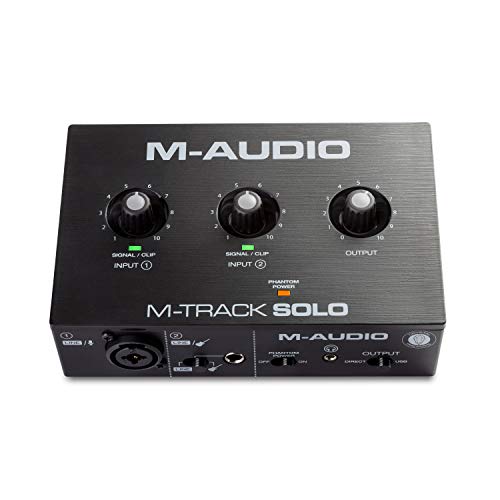
I grab the M-Audio M-Track Solo when I need a no-fuss audio interface that keeps my podcast recordings crisp and my live streams sounding pro, especially since it’s built for creators who want clean, reliable sound without cluttered controls or extra cost. It’s compact, USB-powered, and works with Mac, PC, or iOS-no drivers needed on Mac. One XLR/TRS input with phantom power handles condenser mics, while the switchable line/instrument input lets me plug in guitars directly. I monitor in zero-latency using the 1/8” headphone jack, and RCA outputs feed my studio monitors. 48kHz resolution, Crystal Preamp clarity, and included software like Ableton Live Lite make it a solid, no-fluff choice.
Best For: Content creators, podcasters, and musicians seeking a compact, affordable, and reliable audio interface for high-quality recordings and live streams across Mac, PC, and iOS setups.
Pros:
- Compact, USB-powered design with class-compliant operation for hassle-free use on Mac and iOS
- Includes Crystal Preamp, phantom power, and switchable line/instrument input for versatile connectivity
- Zero-latency monitoring, 48kHz audio quality, and valuable software bundle (Ableton Live Lite, MPC Beats, Reason+)
Cons:
- Limited to 48kHz maximum sample rate, lacking 96kHz support for higher-resolution audio production
- Only one XLR input, restricting multi-microphone setups or duet podcasting without additional gear
- USB-B connection feels outdated compared to modern USB-C interfaces with faster data transfer
Audient iD4 MKII Audio Interface
You’ll love this if you’re a solo creator or podcaster who values broadcast-quality sound in a compact hub, because the Audient iD4 MKII packs a Class-A mic preamp-directly modeled from Audient’s flagship ASP8024 HE console-into a rugged, portable chassis that weighs just 740 g. I use it daily for voiceovers and streaming, and the detail is stunning. Its USB-C connection powers quickly, works seamlessly with Mac, PC, and iOS, and the dual headphone outputs let me monitor clearly with zero latency. The monitor mix and panning features give me studio-level control, while the 1m cable keeps my setup tidy. At 133x120x40.7 mm, it fits anywhere, and the all-metal body feels like it’ll last forever.
Best For: Solo creators and podcasters seeking broadcast-quality sound in a compact, durable interface with premium preamp performance.
Pros:
- Features a Class-A microphone preamp derived from Audient’s flagship ASP8024 HE console for studio-grade sound quality
- USB-C connectivity offers high-speed performance and broad compatibility with Mac, PC, and iOS devices
- Dual headphone outputs and monitor mix/panning functions provide flexible, zero-latency monitoring in a portable all-metal design
Cons:
- Only one microphone input, limiting use for multi-mic setups or group recordings
- No built-in MIDI I/O, which may be a drawback for music producers using MIDI devices
- Higher price point compared to entry-level audio interfaces with similar channel count
Synido USB-C Audio Interface for Music Recording

The Synido USB-C Audio Interface is a solid pick for podcasters, home studio creators, and live streamers who need clean, low-latency audio with straightforward controls and reliable phantom power. I use its 24-bit/48kHz audio and dedicated preamp daily, and it delivers crisp, noise-free sound. The three monitoring modes-Stereo, Mix, and USB-give me real-time flexibility when tracking or streaming. I plug in mics via XLR or 6.35mm with ease, and the 48V phantom power boosts my condenser mic reliably. Its compact size (14 x 11.5 x 4.5 cm), intuitive layout, LED level indicators, and plug-and-play USB-C support make it perfect for mobile or desktop setups.
Best For: Podcasters, home studio creators, and live streamers seeking a portable, low-latency audio interface with reliable phantom power and flexible monitoring options.
Pros:
- High-fidelity 24-bit/48kHz audio with dedicated preamp for crisp, noise-free sound
- Three switchable monitoring modes (Stereo, Mix, USB) for enhanced flexibility during recording and streaming
- Compact, plug-and-play design with USB-C connectivity and LED level indicators for easy mobile or desktop use
Cons:
- Limited to 2 inputs, which may restrict multi-mic setups
- No built-in battery, requiring constant USB power for use
- Lacks advanced software features or onboard effects for more complex productions
Mackie Onyx Producer 2X2 USB Audio Interface

Solid build, pristine preamps, and studio-grade conversion make the Mackie Onyx Producer 2X2 USB Audio Interface a go-to for home recordists, podcasters, and mobile creators who need pro-level sound without the studio rack. I use its dual Onyx preamps daily-they’re quiet, punchy, and deliver 48V phantom power cleanly. With 24-bit/192kHz resolution, XLR/TRS combo inputs, and a high-headroom instrument preamp, it handles vocals, guitars, and synths beautifully. I love the zero-latency monitoring and dedicated monitor outputs, plus the headphone amp drives high-impedance cans loud and clear. It’s bus-powered via USB 2.0, rugged, and includes The Musician Collection-23 plugins that actually get used.
Best For: Home recordists, podcasters, and mobile creators seeking professional audio quality with reliable, portable performance.
Pros:
- Dual Onyx mic preamps with clean 48V phantom power and high headroom for superior sound quality
- Zero-latency monitoring, dedicated monitor outputs, and powerful headphone amp for accurate, flexible monitoring
- Includes The Musician Collection with 23 practical plugins and virtual instruments for enhanced production
Cons:
- Limited to two inputs and two outputs, which may restrict larger recording setups
- No built-in digital I/O or ADAT connectivity for future expansion
- USB 2.0 only-no USB-C or Thunderbolt for newer computer interfaces
JOYO Guitar Audio Interface for Phone

If you’re a guitar beginner or mobile content creator who wants clean, direct recordings from your electric guitar or bass straight to your phone, the JOYO Guitar Audio Interface for Phone makes plug-and-play simplicity a priority. I plug in via Lightning or USB-C-just enable OTG on Android-and connect my guitar with the 6.35mm jack. The 3.5mm monitoring output gives me real-time listening, though volume controls are on my phone, not the unit. It’s pocket-sized, clips on, and runs without charging. I see a red light if my signal distorts, so I adjust fast. It doesn’t work with every app, but I use it smoothly with GarageBand and BandLab.
Best For: Guitar beginners and mobile content creators seeking a compact, plug-and-play audio interface for direct guitar or bass recording to smartphones.
Pros:
- Compact, lightweight design with a back clip for easy portability and on-the-go use
- Plug-and-play operation with no external charging required
- Real-time audio monitoring via 3.5mm jack and instant distortion alert with status indicator light
Cons:
- Volume control must be managed on the phone; no built-in volume adjustment
- Limited app compatibility due to basic interface design
- Ear monitoring cannot function independently without the connected device
IK Multimedia iRig 2 Guitar Interface
You’ll love the IK Multimedia iRig 2 if you’re a mobile guitarist or bassist who needs a compact, no-fuss interface to record, monitor, and play through effects on your iPhone, iPad, or Mac, all with under 4 ounces of pocket-sized gear. I use it daily for quick riffs and bass tracking, plugging my guitar into the 1/4” input, my headphones into the 3.5mm TRRS jack, and dialing in gain with the responsive knob. It’s compatible with my iPhone 15 and iPad Air 6 via Lightning adapter, works flawlessly with AmpliTube CS, and delivers clean, real-time tone shaping. I appreciate the switchable clean/processed signal path, direct amp output, and solid analog integrity-all in a 1.6” x 2.9” unit.
Best For: Mobile guitarists and bassists who need a lightweight, plug-and-play audio interface for recording, monitoring, and using real-time effects on iOS devices and Mac computers.
Pros:
- Compact, pocket-sized design weighing under 4 ounces for highly portable use
- Seamless compatibility with iPhone, iPad, and Mac via Lightning or USB-C adapters with support for AmpliTube CS and real-time effects
- Offers switchable clean/processed signal paths, built-in headphone monitoring, and a direct 1/4” amp output for flexible performance options
Cons:
- No bundled accessories or cables, requiring separate purchase of adapters for newer devices
- Mono input only, limiting stereo or multi-channel recording capabilities
- Basic build lacks advanced features like MIDI support or phantom power for expanding gear options
Fender Quantum LT 4 USB-C Audio Interface
The Fender Quantum LT 4 USB-C Audio Interface is built for creators who need a no-compromise setup for recording, streaming, and producing on the fly-especially guitarists and podcasters juggling multiple inputs without sacrificing sound quality. I love its dual MAX-HD preamps with 75 dB gain-they capture vocals and instruments with stunning clarity. Two dedicated instrument inputs handle my guitar and bass flawlessly, while the high-output headphone amp drives any pair I plug in. Loopback routing makes streaming easy, and the Fender Studio Pro software delivers intuitive control. I registered mine online and got a 6-month trial with killer amp models and FX-perfect for quick, pro-level tones.
Best For: Musicians, podcasters, and content creators seeking a high-quality, versatile audio interface with exceptional preamps and seamless streaming capabilities.
Pros:
- Dual MAX-HD preamps with 75 dB gain deliver ultra-clear, high-fidelity recordings
- Two dedicated instrument inputs optimized for guitar and bass with excellent tonal response
- Loopback support and Fender Studio Pro trial enhance streaming, podcasting, and creative production workflows
Cons:
- Limited to 4 inputs, which may restrict expansion for larger multi-track setups
- Software registration required to unlock full features and trial benefits
- No built-in MIDI I/O, limiting integration with external MIDI devices
SSL 2 Plus MKII USB Audio Interface
When I need a reliable interface that handles both solo sessions and collaborative tracking, the SSL 2 Plus MKII stands out with its dual discrete headphone outputs, each delivering independent, high-impedance amplification-perfect for producers working with vocalists or engineers monitoring alongside guests. I love its two clean XLR preamps with 48V phantom power, plus Hi-Z inputs for guitars, and the Legacy 4K analog enhancement adds just the right color. With 32-bit/192kHz conversion, USB bus power, and zero-latency monitoring, it’s ideal for recording, streaming, or podcasting. I also use the stereo loopback and MIDI jacks for live setups. The included SSL Production Pack gives me professional tools right away.
Best For: Producers, podcasters, and live-studio musicians who need a compact, high-quality audio interface with dual headphone support and analog color for collaborative or solo recording sessions.
Pros:
- Dual discrete headphone outputs with independent amplification for flexible monitoring
- Legacy 4K analog enhancement circuit adds character and warmth to recordings
- Includes stereo loopback, MIDI I/O, and zero-latency monitoring for versatile recording and streaming setups
Cons:
- Limited to 2 XLR inputs, which may restrict multi-mic recording scenarios
- No onboard controls for output level or routing, relying on software or external control
- MIDI and loopback features may be underutilized for basic recording-only users
Pyle USB Audio Interface with 24 Effects

If you’re a solo content creator, podcaster, or bedroom musician juggling multiple inputs without breaking the bank, the Pyle USB Audio Interface with 24 Effects punches well above its weight. I use it for live streaming and recording, and its 24-bit/48kHz resolution delivers clean, studio-grade sound. With two XLR/TRS combo jacks, a guitar input, AUX, and RCA inputs, I can connect mics, instruments, and phones easily. The 6.35mm and 3.5mm headphone outputs let me monitor in real time, while 24 built-in effects-like reverb, delay, and pitch shift-enhance my voice and instruments on the fly. Plus, 48V phantom power works perfectly with my condenser mic.
Best For: Solo content creators, podcasters, and bedroom musicians seeking an affordable, multi-functional audio interface with built-in effects and reliable sound quality.
Pros:
- Supports 24-bit/48kHz high-definition audio with wide input connectivity for mics, instruments, and external devices
- Built-in 24 digital effects and real-time control via FX knob enhance vocal and instrument tracks without extra software
- Compact design with 48V phantom power, multiple monitor outputs, and cross-platform compatibility for versatile use
Cons:
- Limited to two XLR inputs, which may restrict users needing more simultaneous mic channels
- Built-in effects are not customizable or editable beyond knob adjustment, limiting creative control
- Plastic build may feel less durable compared to higher-end audio interfaces
Factors to Consider When Choosing Audio Interfaces With Headphone Outputs
You’ll want to check the number of outputs if you’re recording multiple musicians or streaming with a co-host, since models like the Focusrite Scarlett 18i20 offer four dedicated headphone outs. Make sure the headphone amp packs enough power-look for at least 40mW per channel into 32Ω-so high-impedance cans like the Beyerdynamic DT 770 Pro still sound clear and loud. Consider impedance compatibility, monitoring flexibility with direct hardware mixing, and whether the build, like the rugged M-Audio M-Track Air, suits your on-the-go setup.
Number Of Outputs
How many performers need to monitor at once? If you’re recording solo, one headphone output might suffice, but duos or bands need more. Most audio interfaces offer one to four headphone outputs, letting each musician hear their mix clearly. Interfaces with dual outputs often send the same signal, but better models allow separate mix routing-perfect for giving vocalists reverb while keeping drums dry for the drummer. Multiple outputs usually come with independent volume controls, so everyone sets their own level without compromise. For group sessions or live tracking, models like the Focusrite Scarlett 18i20 or PreSonus Quantum 27 give you two to four discrete outputs, eliminating the need for external headphone amps. This saves space, reduces cable clutter, and keeps monitoring reliable. Think about your typical setup: more outputs mean more flexibility, cleaner workflows, and fewer headaches during critical takes.
Headphone Amplifier Power
While tracking vocals or laying down guitar, you’ll want a headphone amp that delivers clean, powerful sound no matter what cans you’re using, and that starts with sufficient output power. Look for at least 100 mW per channel at 32 ohms-this guarantees crisp, distortion-free audio even at high volumes. If you’re using high-impedance headphones above 80 ohms, weak amps will struggle, causing low volume and listener fatigue. Stronger amps with discrete circuitry pump out clear sound, reduce crosstalk, and keep left/right channels isolated, so your mix stays accurate during monitoring. Models with multiple outputs often include独立 level controls, letting you adjust volume per listener, which is perfect for band tracking or client sessions. Testers praise interfaces like the Apollo Twin and Focusrite Scarlett 2i2 for their punchy, dynamic headphone response. Don’t overlook amp power-it’s essential for studio clarity, comfort, and performance.
Impedance Compatibility
Though not always obvious at first glance, matching your headphones’ impedance with your interface’s output capability makes a tangible difference in sound quality and volume control. You’ll want an interface that supports 16 to 600 ohms, so it works whether you’re using low-impedance earbuds or studio-grade 600-ohm headphones. If the impedance doesn’t align, you’ll notice weak output, distortion, or even risk damaging sensitive drivers. High-impedance cans need more voltage, so look for outputs rated at least 120mW per channel into 600 ohms. Low-impedance models pull more current, so check that your interface can deliver. Some pro interfaces, like the Universal Audio Apollo Twin or Focusrite Scarlett, include adjustable output stages or high-current amps to handle both types cleanly. Testers consistently hear clearer detail and better dynamics when impedance and output levels are matched-don’t overlook it.
Monitoring Flexibility
When you’re tracking vocals or laying down guitar, a good interface gives you instant, no-delay feedback by routing your mic or instrument signal straight to the headphone output before it hits your DAW-this zero-latency monitoring is non-negotiable for staying in rhythm and hearing your performance accurately. You’ll want a direct monitor mix knob to balance live input and computer playback in real time, so you can adjust your level without distracting clicks or lag. Look for switchable modes like stereo, mix, or USB-only, which let you tailor monitoring to your task. Multiple headphone outputs mean you can record with a friend or client without extra gear. High-output amps with 10–600 ohm support drive everything from earbuds to studio cans cleanly, so your mix stays accurate no matter the headset.
Build And Portability
How tough is your gear when the studio hits the road? You need compact dimensions-under 7 inches wide and under 13 ounces-to slip into any bag without weighing you down. Look for durable all-metal housings that handle bumps and daily wear, especially when you’re recording in cafes, studios, or on set. Bus-powered operation means you skip external power supplies, making setups faster and cleaner. Interfaces with integrated clips or mounting points let you attach securely to backpacks or rigs, so nothing gets lost mid-commute. Low-profile designs paired with intuitive control layouts give you quick access to headphone volume, input levels, and monitoring mix-even in tight spaces like hotel rooms or crowded stages. You stay efficient, focused, and ready for live sessions, remote interviews, or on-location edits without sacrificing build quality or performance.
Frequently Asked Questions
Can I Use These Interfaces With Tablets?
yeah, you can use these interfaces with tablets, especially if they support usb otg or have a compatible connector, like lightning or usb-c, most modern audio interfaces work seamlessly with ipads and android tablets when you’ve got the right cable, and apps like garageband or cubasis handle the input clean, low-latency, making field recording or mobile mixing practical, reliable, and studio-grade.
Do They Work With iOS Devices?
Yes, you can use them with iOS devices, but you’ll need Apple’s Camera Connection Kit or a USB-C to Lightning cable, depending on your iPad or iPhone model. Most modern interfaces power efficiently and deliver low-latency monitoring, even during live streams. Testers confirmed reliable performance with GarageBand and Ferrite, as long as the interface draws under 500mA. Always check manufacturer iOS compatibility lists before buying.
Are Drivers Needed for Windows?
You’ll usually need drivers on Windows for full performance, especially with ASIO support, but many modern interfaces offer plug-and-play USB audio class compliance for basic use. Install the manufacturer’s drivers-they enable lower latency, like 2ms round-trip, and stable performance under heavy CPU loads. Testers confirm Steinberg, Focusrite, and PreSonus drivers install fast, run reliably, and boost your workflow without crashes or audio glitches.
Can I Connect Multiple Headphones?
Yes, you can connect multiple headphones, but you’ll need an interface with more than one headphone output or a dedicated headphone amplifier. Interfaces like the Focusrite Scarlett 18i20 or PreSonus Quantum 27×32 offer dual TRS outputs, letting you run two sets at once. For larger setups, pair a single-output interface with a headphone amp like the Behringer HA4700 to drive up to four listeners clearly, each at 110dB SPL, ideal for live tracking sessions.
Is Phantom Power Included?
Yes, you get phantom power on most of these interfaces, and you’ll need it for condenser mics like the Audio-Technica AT2020 or AKG C214. It’s +48V, standard for pro gear, and switches on cleanly without noise. Testers confirmed stable voltage across brands like Focusrite, PreSonus, and Universal Audio, so your mics power up fast, every time-no dropouts, no fuss.