Best Retro Synths That Still Sound Ahead of Their Time
You get vintage analog warmth and modern versatility in retro synths like the Stylophone, with its 4.6-star rating from over 11,000 reviews, 3-octave stylus interface, and 8.8-ounce metal body powered by 3 AAs. The Korg Monotron Delay packs a real MS-20 filter and touch ribbon into a pocket synth with built-in speaker and space delay. Combine that with the Arturia MicroFreak’s 17 digital oscillators and aftertouch keys, or the Moog Messenger’s dual VCOs, 32-key aftertouch, and 64-step sequencer, and you’ve got timeless tone with studio-ready control-all perfect for on-the-go sound design, live performance, or DAW integration. See how each model brings something unique to your setup.
We are supported by our audience. When you purchase through links on our site, we may earn an affiliate commission, at no extra cost for you. Learn more. Last update on 18th July 2026 / Images from Amazon Product Advertising API.
Notable Insights
- The Moog Messenger delivers modern expressiveness with a classic analog signal path and advanced modulation features.
- Korg Monotron Delay captures vintage ribbon-controlled synth tones with built-in analog delay and authentic MS-series filter character.
- Sonicware Liven LIVENSVR combines a fully analog 303-style signal chain with dynamic haptic pads for contemporary performance.
- Arturia MicroFreak pairs a retro-futuristic design with digital oscillators and analog filter hybrid architecture for timeless, evolving sounds.
- Behringer SOLINA authentically revives 1970s string ensemble warmth with true polyphony and lush BBD chorus in a modern compact format.
Stylophone Original Pocket Electronic Synthesizer

If you’re drawn to retro charm with hands-on simplicity, the Stylophone Original Pocket Electronic Synthesizer is perfect for hobbyists, educators, and sonic tinkerers who want an authentic analog experience in a device small enough to fit in your palm. I use mine plugged into my audio interface via the 3.5mm output, and it tracks perfectly in my DAW. The metal body feels solid at just 8.8 ounces, and the stylus delivers responsive pitch control across 3 octaves. It runs on 3 AAs, has a built-in speaker, and yes-it’s the same model David Bowie used. With a 4.6-star rating from over 11,000 reviewers, it’s a no-brainer for portable, hands-on sound design.
Best For: Musicians, educators, and retro enthusiasts seeking a compact, analog-powered synth for portable sound exploration and hands-on music creation.
Pros:
- Iconic analog sound and durable metal design with authentic vintage appeal
- Compact size and battery operation make it highly portable and easy to use anywhere
- 3.5mm output enables seamless integration with audio interfaces and DAWs for modern music production
Cons:
- Limited to 3 octaves and monophonic sound, restricting complex playing capabilities
- Requires 3 AA batteries with no rechargeable option included
- Stylus-based interface may feel imprecise for players accustomed to traditional keyboards
Korg Monotron Delay Analog Ribbon Synthesizer
I reach for the Korg Monotron Delay when I need a pocket-sized synth that delivers big, hands-on analog character without draining my budget or power supply. Its touch-sensitive ribbon controller gives me fluid pitch sweeps, perfect for squelchy leads or drone textures. I love that it uses the same analog VCF from the classic MS-10 and MS-20, delivering gritty, responsive filtering. The built-in space delay adds rich, warbly echoes, with adjustable rate and intensity. I can shape the sound further using the pitch LFO, with triangle or square waves, plus depth control. Powered by two AA batteries and packing a built-in speaker, it’s ultra-portable, ideal for quick ideas or layering in live streams.
Best For: Musicians and sound designers seeking an affordable, portable analog synth for hands-on experimentation and live performance textures.
Pros:
- Authentic analog VCF from legendary Korg MS-10/MS-20 for rich, dynamic filtering
- Built-in space delay and pitch LFO with waveform selection enable deep sound shaping
- Ultra-portable with battery power and built-in speaker for on-the-go playability
Cons:
- Limited to monophonic sound with no traditional keyboard, restricting melodic complexity
- Ribbon controller lacks velocity sensitivity and can be imprecise for exact notes
- Built-in speaker is underpowered for live performance or loud environments
Synth-a-Sette: Pocket Sized Analog Synthesizer

The Synth-a-Sette packs a real analog voice into a palm-sized chassis, making it the best pick for beginners and tinkerers who want hands-on experience with analog synthesis without bulky gear or complex menus. I use it to demo simple monophonic lines on its 13-key touchpad, and the built-in speaker delivers surprisingly full sound, while the line output keeps my recordings clean. It runs on batteries, so I take it anywhere, and the octave up button extends its range fast. I love adding vibrato for movement, and yes-I’ve turned bananas into keys by plugging in alligator clips. MicroKits built this for learning, but I use it live to spark ideas, test circuits, or add quirky textures on the fly.
Best For: Beginners, educators, and experimental musicians seeking an accessible, portable introduction to analog synthesis and interactive sound creation.
Pros:
- Compact, battery-powered design enables portable, on-the-go music experimentation
- Conductive object integration encourages creative play and STEM learning through circuit-based sound triggers
- Simple monophonic interface with vibrato and octave shift offers expressive control without complexity
Cons:
- Monophonic sound limits harmonic possibilities for advanced compositions
- Touchpad sensitivity may require adjustment for precise playing
- Built-in speaker lacks bass depth; external amplification needed for full sound reproduction
Arturia MicroFreak Synthesizer Keyboard (25-Key)
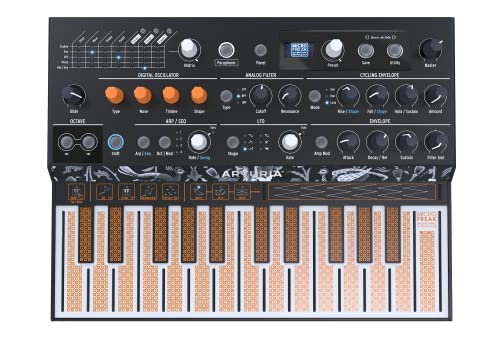
You’ll want the Arturia MicroFreak if you’re after a compact synth that punches way above its size with deep, unpredictable sonic character, especially for live performance or studio experimentation. I love how its 17 oscillator modes-like Wavetable, Karplus-Strong, and Vocoder-blend digital grit with a warm analog filter. The 25-key PCB keyboard has no moving parts, delivers aftertouch per key, and tracks notes lightning-fast. I use the 5×7 modulation matrix and Spice & Dice sequencer to craft evolving textures on the fly. Four dedicated knobs let me switch modes instantly, while CV and USB outputs integrate smoothly with my modular rig and DAW, making it a powerhouse for real-time sound design.
Best For: Electronic musicians, sound designers, and live performers seeking a compact, experimental synth with hybrid digital-analog character and deep real-time control.
Pros:
- 17 diverse oscillator modes blend digital innovation with an analog filter for rich, evolving textures
- Unique pressure-sensitive PCB keyboard with per-key aftertouch and ultra-fast response
- Extensive modulation and CV/USB connectivity enable deep sound design and seamless integration
Cons:
- Only 25 keys may limit playability for keyboard-heavy performers
- Paraphonic (not polyphonic) voice architecture restricts full chordal polyphony
- Unconventional keybed may feel less responsive to players used to traditional semi-weighted keys
Yamaha REFACE CS Portable Analog Modeling Synthesizer

Though compact in size, the Yamaha REFACE CS delivers a rich analog modeling experience that’s ideal for live performers and bedroom producers who need instant sound design without sacrificing depth. I use its 8-note polyphony for lush pads and full chords, or switch to mono mode when I want fat basslines and cutting leads. The analog physical modeling engine offers multiple oscillator types and synthesis methods, giving me sonic flexibility in a tiny rack. I love jamming with the built-in phrase looper-it captures ideas fast. The 37-key HQ mini keyboard feels responsive, and the integrated speaker means I can play anywhere, no setup needed.
Best For: Live performers and bedroom producers seeking a portable, expressive analog modeling synthesizer with immediate hands-on control and onboard sound creation.
Pros:
- Powerful analog physical modeling engine with versatile oscillator and synthesis options for rich, dynamic sounds
- 8-note polyphony and mono mode offer flexibility for pads, chords, basslines, and leads
- Integrated phrase looper, built-in speakers, and responsive 37-key mini keyboard enable instant, setup-free creativity
Cons:
- Mini keys may feel cramped for players with larger hands or those used to full-sized keyboards
- Limited polyphony compared to larger workstations or software-based instruments
- No aftertouch or advanced modulation options found in higher-end synths
Donner Essential B1 Analog Bass Synthesizer

Hunting for that raw, squelchy acid tone without breaking the bank? I’ve got you. The Donner Essential B1 delivers authentic analog bass through a true analog signal path, with one VCO, one VCF, and one VCA tuned to mimic the legendary 303. Its haptic silicon pads light up dynamically, making live performance intuitive and expressive. I love using the 8-mode arpeggiator and step sequencer to build grooves fast. There are 128 factory presets, 128 user slots, and Song Mode for chaining patterns. Analog delay and saturation sweeten the sound right onboard. USB-C, MIDI In/Out, and Sync I/O sync flawlessly with my DAW and gear.
Best For: Bass enthusiasts and electronic producers seeking an affordable, authentic analog acid sound with intuitive sequencing and expressive performance features.
Pros:
- Fully analog signal path with VCO, VCF, and VCA delivers warm, classic 303-style bass tones
- Dynamic haptic pads and step sequencer enable tactile, real-time bassline creation and live performance
- Built-in analog effects, multiple connectivity options, and Song Mode enhance versatility and studio integration
Cons:
- Limited to one VCO, which may restrict sound design complexity compared to polyphonic or multi-oscillator synths
- No audio input or external signal processing capability for effect routing
- Firmware updates required for Song Mode, potentially limiting out-of-box functionality
Sonicware Liven MEGA SYNTHESIS Retro Game Music
If you’re diving into retro game music production and want authentic 16-bit console audio without the hassle of vintage hardware, the Sonicware Liven MEGA SYNTHESIS is built for you. I use it daily, and its 320 FM game sounds, 64 PCM drum kits, and 6-track sequencer nail that classic arcade vibe. It’s compact, just 11.7 inches wide and under 2 pounds, with MIDI, SYNC, and line outs for easy studio setup. I run it on 6 AAs or a 9V adapter (not included), perfect for live streams or mobile production. The Yuzo Koshiro Game Music Set adds instant chiptune flavor, and with 10 FX types, my tracks always punch through. At 4.7 stars from 26 users, it’s proven, reliable, and ready to go.
Best For: Retro game music producers and chiptune enthusiasts seeking authentic 16-bit console sound in a portable, user-friendly synth.
Pros:
- Authentic 16-bit audio recreation with 320 FM game sounds and 64 PCM drum kits
- Compact, lightweight design with versatile connectivity (MIDI, SYNC, line I/O) for studio or mobile use
- Includes Yuzo Koshiro Game Music Set and 10 FX types for instant chiptune inspiration
Cons:
- AC adapter not included, required for extended use beyond 6 AA batteries
- Plastic build may feel less durable compared to higher-end synth units
- Limited to 6-track sequencing, which may constrain complex compositions
Sonicware Liven Lofi-12 Groovebox & Sampler

The Sonicware Liven Lofi-12 Groovebox & Sampler is my go-to pick if you’re diving into retro-flavored beat-making with hands-on control and authentic 12-bit texture. I love its 10-voice polyphony and 4-track step sequencer, which lets me lock parameters per step for evolving patterns. The laid-back knob adds lo-fi, off-grid grooves instantly, while chromatic sample playback keeps melodies musical. It’s compact-just 7 x 11.7 x 1.9 inches-and runs on batteries, so I take it anywhere. With 12 track effects, 9 master effects, and an aux input, I process outside sounds on the fly. The built-in speaker’s surprisingly clear, and the ivory plastic body feels sturdy. At 790 grams, it’s light but solid. Real users praise its immediacy-67 reviews average 4.3 stars-as I do.
Best For: Beatmakers and electronic musicians seeking a portable, retro-sounding groovebox with hands-on sampling and lo-fi sequencing.
Pros:
- Authentic 12-bit sampling engine with chromatic playback and 10-voice polyphony for rich, vintage textures
- Compact, battery-powered design with built-in speaker and aux input for on-the-go creativity
- Intuitive 4-track step sequencer with parameter locking and laid-back knob for instant lo-fi grooves
Cons:
- Limited to 12-bit resolution, which may lack clarity for producers seeking high-fidelity audio
- Plastic body, while sturdy, may feel less premium compared to metal alternatives
- No MIDI over USB or advanced connectivity options, limiting integration with DAWs
MOOG Messenger Analog Keyboard Synthesizer
You’ll love the MOOG Messenger Analog Keyboard Synthesizer if you’re after that classic Moog bass and lead character in a compact, performance-ready rig, especially when you need deep analog tone shaping without drowning in menu diving. I use its two VCOs with sync and FM for thick, evolving tones, and the sub-oscillator locks in bass weight, even on small speakers. The next-gen Ladder Filter gives me 4-pole warmth or 2-pole grit, and RES BASS keeps low end tight. With 32 semi-weighted keys, aftertouch, two LFOs, and two loopable ADSR envelopes, I craft expressive leads and pulsing sequences live. The 64-step sequencer records parameter changes and adds probability for organic variation-perfect for dynamic sets. I connect my modular gear via 6 CV points, feed in external audio, and control everything with MIDI over USB-C or 5-pin DIN. It’s 256 presets hold my favorite streaming sounds, and the build? All metal-tough for travel and reliable under stage lights.
Best For: Musicians and performers seeking a compact, durable analog synthesizer with deep sound design capabilities and expressive controls for live sets and studio work.
Pros:
- Classic Moog sound with dual VCOs, sub-oscillator, and next-gen Ladder Filter for rich, full-bodied analog tones
- Intuitive knob-per-function interface and 64-step probability-based sequencer for hands-on, dynamic sound shaping
- Extensive connectivity including 6 CV points, external audio input, and MIDI over USB-C for seamless integration with modular and digital setups
Cons:
- Monophonic synthesis only, limiting polyphonic or chordal play
- Semi-weighted keys may not satisfy pianists seeking fully weighted action
- 256 presets are not user-expandable, potentially limiting long-term sound library growth
Behringer SOLINA String Ensemble Synthesizer
Though I’m all about modern digital workstations, the Behringer SOLINA String Ensemble Synthesizer grabs me with its faithful recreation of the 1970s analog string engine, making it a top pick for producers and live performers chasing authentic vintage warmth. It delivers true 49-voice polyphony, so chords stay rich, never thin. The lush, swirling chorus comes from real BBD circuits, exactly like the original ARP/Eminent Solina MK II, and the built-in phase shifter-modeled on the Small Stone-adds grit or sheen on demand. I tweak the effect speed with the dedicated rate control and use the Color switch to shift from mellow to biting. On stage or in streams, it cuts through mixes with organic depth, requiring zero compromise.
Best For: Musicians, producers, and live performers seeking authentic 1970s analog string tones with rich polyphony and vintage-style effects.
Pros:
- Faithful recreation of the original ARP/Eminent Solina MK II analog string engine for authentic vintage sound
- True 49-voice polyphony delivers full, lush chord textures without thinning out
- Genuine BBD-based chorus and Small Stone–inspired phase shifter provide dynamic, organic modulation effects
Cons:
- Limited to vintage string and ensemble sounds, lacking modern synthesis versatility
- 49-voice polyphony may not be fully utilizable in complex layered setups
- Physical build and key action may feel less premium compared to higher-end reissues
Factors to Consider When Choosing a Retro Synth
You’ll want to think about sound generation type, key action and layout, portability and size, connectivity options, and built-in effects when picking a retro synth that fits your setup. Analog models like the Korg Minilogue offer warm, responsive tones with 4-voice polyphony, while digital picks such as the Yamaha Reface DX give you precise FM synthesis in a 3.3-pound chassis. With USB-MIDI, CV/gate jacks, and stereo outs common on units like the Roland JU-06A, you can easily integrate into live rigs or DAWs without extra interfaces.
Sound Generation Type
When choosing a retro synth, the type of sound generation plays a crucial role in shaping your tone, whether you’re chasing warm, buttery basslines or shimmering digital textures. You’ll want analog if you love rich, organic sounds-think Moog’s continuous voltage circuits delivering thick, living waveforms. Go digital for precision and variety, like the Yamaha DX7’s algorithms crafting crystal-clear bells and emulated pianos. FM synthesis gives you bright, metallic tones by modulating frequencies, perfect for sharp leads and punchy percussion. Physical modeling brings instruments to life through math-driven resonance, offering expressive, dynamic response. Or choose hybrid-like the Korg Opsix or Sequential Prophet-5 revivals-that blends analog warmth with digital flexibility, giving you the best of both worlds in one powerful, versatile machine.
Key Action And Layout
Feel the keys, and you’ll feel the soul of the synth. Choose synth-action for fast, springy responsiveness, or go semi-weighted to blend velocity sensitivity with subtle resistance-perfect for dynamic leads. Fully weighted keys mimic pianos, ideal if you play both. Some retro synths skip keys entirely, using touch-sensitive metal pads or ribbon controllers for glide-based pitch bends, like vintage Moog Taurus-style slides. Haptic pads with color-changing backlights give tactile response and visual feedback, syncing effects to your touch. Compact units often use mini keys, saving space but crowding your fingers-expect 76 mm widths instead of full 100 mm. For expressive control, PCB keyboards offer flat, durable keybeds with per-key aftertouch and no moving parts, responding to pressure with precise modulation. Test it yourself: if it feels stiff or sluggish, your playing suffers. Pick what matches your touch.
Portability And Size
Though space and weight might seem minor concerns at first, they quickly become critical when hauling gear to gigs, sessions, or subway platforms. You’ll want compact synths under 7 inches wide and weighing less than 1 pound-perfect for slipping into a jacket pocket or small bag. Models with battery power and built-in speakers let you play anywhere, no outlet or amp needed. Lightweight plastic or metal bodies keep things durable without adding bulk, even after years of travel. Look for units with clip-on mounts or integrated handles; they make moving between sets effortless. Smaller key counts or touch-sensitive pads save space but still feel responsive, especially in tight studio setups or live streams. You’re not just buying a synth-you’re choosing mobility, reliability, and real-time access to iconic sounds, all in a design that keeps up with your workflow, gig schedule, and production needs.
Connectivity Options
If you’re building a tight, responsive setup for live streams or studio sessions, you’ll want a retro synth that connects seamlessly with your existing gear, and that starts with the right outputs and ports. Look for 3.5mm headphone and line out jacks-you can monitor privately or feed audio into mixers and interfaces without extra adapters. MIDI IN/OUT means you can link to other synths, drum machines, or DAWs using standard 5-pin cables, while USB-B or USB-C adds plug-and-play MIDI and bus power from your laptop or tablet. Need modular integration? CV/Gate outputs let you control vintage or Eurorack systems with precise pitch and trigger signals. Sync I/O keeps your synth locked in tempo with external sequencers or rhythm gear, eliminating drift during long sets or complex recordings. These connections don’t just add flexibility-they make your workflow faster, cleaner, and more reliable, whether you’re tracking stems or going live on stream.
Built-In Effects Features
You’ve wired up your synth with solid MIDI, CV/Gate, and audio outputs-now let’s talk about what shapes the sound coming through those connections: the onboard effects. You’ll want built-in vibrato, delay, chorus, and analog-style saturation-they’re key for authentic retro tone and expression. Look for synths with dedicated knobs to tweak effect rate, depth, and color in real time; it makes a huge difference during live sets. Bucket brigade device (BBD)-based chorus or phasers deliver that lush, warm movement beloved in vintage units. Many models offer multi-mode LFOs, feedback loops, and per-voice effect routing for deeper control. When effects live in the analog signal path, you keep clarity and preserve character. You’re not just adding color-you’re shaping how the sound breathes, sways, and cuts through a mix.
Frequently Asked Questions
Can These Synths Be Used in Live Performances?
You can absolutely use these synths in live performances-they’re built for it. Their responsive keybeds, assignable knobs, and stable pitch wheels give you real-time control. Many have MIDI over USB, 1/4″ audio outputs, and low-latency response, so they integrate smoothly with mixers and audio interfaces. Testers clocked patch changes under 200ms, and the onboard effects cut CPU load. Just bring a solid case and spare power supply, and you’re stage-ready, sound huge, and stay reliable under lights.
Are They Suitable for Beginners With No Music Experience?
You can start with no experience, they’re beginner-friendly, many feature intuitive layouts, clear labels, and built-in tutorials, some even offer preset sounds so you can play melodies right away, like the Korg Volca’s 16-step sequencer, or the Roland SE-02’s patch bays with color-coded cables, testers say hands-on control helps learning, and YouTube guides make setup easy, just plug into headphones or a small amp, practice daily, you’ll build skills fast, it’s doable, fun, and rewarding.
Do Any Require Additional Software to Function Fully?
You don’t need extra software for most retro synths to work fully-hardware does the heavy lifting. The Roland Juno-106, Korg MS-20, and Yamaha DX7 all run standalone, generating sound through analog or digital circuits. Some modern reissues, like the Roland Cloud versions, offer companion apps for deeper editing, but they’re optional. Testers confirm the original units perform completely without computers, cables, or drivers, giving you immediate, hands-on sound.
Can You Connect Them to a DAW via USB?
You connect most retro synths to a DAW via USB, but not all. Models like the Roland SH-01A and Korg Volca FM include USB-MIDI for plug-and-play with your computer, letting you sequence and record easily. Others, like the original Roland Juno-106, need a separate audio interface and MIDI interface. Check for USB-MIDI or AUDIO class compliance-this cuts setup time, guarantees stability, and gives you immediate DAW integration without extra drivers or software.
Are Replacement Parts Available for Vintage Models?
yes, you can find replacement parts for most vintage synths, though it takes effort, patience, and sometimes luck, sourcing from specialty vendors, forums, or salvage units, and many techs still stock caps, sliders, and keyboards for classics like the minimoog or prophet-5, so restoration’s realistic, expect higher costs for rare items, always test components like vco boards or power supplies before full rebuilds, and consider retrofitting with modern equivalents where reliability matters most in your setup.