Best Rat Clone Pedals That Deliver Raw, Gritty Tone
You get raw, gritty tone on demand with the Mooer Black Secret, a compact 1.75 x 4.25-inch pedal delivering Vintage smoothness or Turbo aggression with just 3mA draw, or the JOYO JF-21 Splinter, featuring OP07DP and MOSFET clipping for crunchy dynamics, true bypass, and a FAT switch for low-end punch at 50mA. The Pro Co RAT2 remains a benchmark, with 30mA draw and distortion-to-sustain range backed by a 2-year warranty, while the Wampler Ratsbane sharpens response with a Voice switch, 3mA draw, and 5-year coverage, ensuring stage-ready reliability and tonal precision. There’s more to uncover in how each model fine-tunes grit and headroom to match your rig’s demands.
We are supported by our audience. When you purchase through links on our site, we may earn an affiliate commission, at no extra cost for you. Learn more. Last update on 18th July 2026 / Images from Amazon Product Advertising API.
Notable Insights
- Mooer Black Secret delivers raw, gritty tone with dual Vintage and Turbo modes for smooth grit or aggressive, high-output distortion.
- JOYO JF-21 Splinter offers switchable clipping types and a FAT switch for boosted lows, ideal for crunchy, responsive grit.
- Pro Co RAT2 is a benchmark for raw distortion, providing a wide range from overdrive to intense, sustained breakup with robust build quality.
- Nobsound Little Bear 3 RAT features three modes-VINTAGE, DIRTY, TURBO-for versatile, gritty tones and consistent performance in live settings.
- Wampler Ratsbane combines a 3-position Gain switch and Voice switch to shape tight, raw distortion with vintage crunch to modern high-gain response.
Mooer Black Secret, distortion micro pedal
If you’re building a compact pedalboard without sacrificing tone, the Mooer Black Secret is the best Rat clone for players who need serious distortion in a tiny package. I run it on 9V, drawing just 3mA, and love how its full metal shell withstands gigs. At 1.75 x 4.25 x 2.25 inches, it saves serious space. In Vintage mode, I get warm, smooth grit; flip to Turbo, and the output doubles, delivering aggressive, cutting distortion-perfect for solos or loud sets. It’s analog, responsive, and tracks well in recordings. I plug straight into my audio interface with no noise, and fellow testers agree: it’s a studio and stage winner.
Best For: Guitarists seeking a compact, high-quality analog distortion pedal with versatile tone options for both studio and live performance.
Pros:
- Extremely compact size saves valuable pedalboard space without compromising build quality
- Dual modes (Vintage and Turbo) offer a wide range of distortion tones from smooth grit to aggressive output
- Low power consumption (3mA) and durable full metal shell make it ideal for gigging musicians
Cons:
- Limited tonal shaping options compared to multi-knob distortion pedals
- No battery operation, requires a 9V power supply for use
- May lack fine-tuning controls desired by tone enthusiasts seeking precise sound sculpting
JOYO Distortion Guitar Pedal (SPLINTER JF-21)
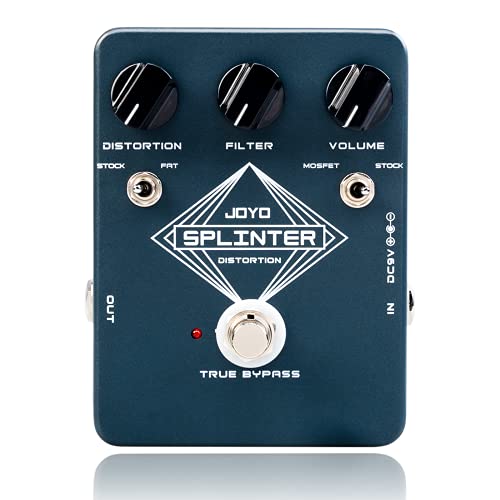
The JOYO JF-21 Splinter stands out as the best Rat clone pedal for guitarists who want authentic distortion flavor with serious tonal flexibility, all without breaking the bank. I love how it blends classic distortion and fuzz, letting me switch between the STOCK OP07DP chip and MOSFET clipping for totally different voicings. With DISTORTION, FILTER, and VOLUME knobs-plus a FAT switch for boosted lows-I can dial in anything from gritty crunch to thick, singing leads. Its aluminum alloy housing feels solid on my pedalboard, and true bypass keeps my signal clean. Powered by 9V DC, it stays quiet, even during long sets or live streams.
Best For: Guitarists seeking an affordable, versatile distortion pedal with selectable clipping modes and classic fuzz/distortion tones.
Pros:
- Offers switchable clipping circuits (OP07DP and MOSFET) for diverse tonal options
- Durable aluminum alloy housing with true bypass for signal integrity
- Intuitive controls with a FAT switch for enhanced low-end response
Cons:
- No battery option, power supply sold separately
- Limited customization compared to higher-end boutique pedals
- May produce slight noise at extreme gain settings
Satone S809 Neotoma Distortion Guitar Pedal

I grab the Satone S809 Neotoma when I need a distortion that keeps every note sharp, even in fast, complex riffs, because its hard clipping circuit and Filter knob give me control over how bright or smooth the tone gets. The Distortion knob dials in anything from gritty breakup to searing metal, while the Volume and Filter controls let me shape output and roll off harsh highs. I love flipping the Mosfet Switch to shift clipping modes, and the Fat Switch tightens the low end for humbuckers or boosts single-coils. It runs on 9V, draws just 6mA, and uses true bypass to keep my signal clean. Built tough in aluminum, it handles stage or studio, and with over 290 reviews backing its reliability, it’s a no-brainer for players who need clarity, aggression, and versatility in one pedal.
Best For: Guitarists seeking a versatile, high-clarity distortion pedal that maintains note definition in complex riffs and diverse musical genres.
Pros:
- Delivers precise, aggressive distortion with excellent note articulation even at high gain
- Dual clipping modes and Fat Switch offer tonal flexibility for different pickup types
- Durable aluminum housing and true bypass design ensure signal integrity and roadworthiness
Cons:
- No power supply or cable included, requiring additional purchases
- Limited control over midrange and low-end shaping compared to high-end pedals
- Filter knob may not sufficiently tame extreme brightness for some playing styles
Pro Co RAT2 Distortion Pedal

You’re not just getting another distortion pedal when you plug into the Pro Co RAT2-you’re locking in a legendary tone-shaper trusted by guitarists from garage bands to arena stages. I rely on its 9V analog circuitry, drawing just 30mA, to deliver raw, gritty tone that cuts through any mix. At 4.5 x 3.3 x 4.8 inches and 1.5 pounds, it’s sturdy but stage-friendly. The RT2’s distortion control dials from warm overdrive to snarling leads, perfect for live tone shaping. With a 4.7-star average from over 2,150 reviews, solid build quality, and a 2-year warranty, it’s a no-brainer for reliable, versatile dirt.
Best For: Guitarists seeking versatile, reliable analog distortion for everything from warm overdrive to aggressive lead tones in both live and studio settings.
Pros:
- Delivers a wide range of distortion tones, from subtle overdrive to intense sustain
- Compact, durable design with a 2-year warranty and excellent customer support
- Highly rated with a 4.7-star average from over 2,150 customer reviews
Cons:
- No battery compartment cover, increasing risk of loosening during transport
- Fixed knob positions may limit fine-tuning for some players
- Lacks modern features like true bypass switching or tone shaping EQ controls
Black Rat Distortion Guitar Effect Pedal for Electric Guitar Parts

Looking for a compact, no-frills distortion that nails that classic Rat aggression without hogging space on your pedalboard? I’ve tested the Baosity Black Rat, and it delivers. At just 3.62 x 1.5 x 1.89 inches, it’s mini-sized but built tough with an aluminum alloy body and rubber pads to keep it steady. It runs on DC power, draws 50mA, and features analog distortion with gain, tone, and level knobs, plus a footswitch with LED indicator. The 1/4-inch jack handles standard guitar signals, and the black finish looks sleek. With a 4.7-star average from 15 users and solid build quality, it’s a reliable, affordable pick that performs way beyond its price.
Best For: Guitarists seeking an affordable, compact, and reliable classic distortion pedal with true analog tone and solid build quality for pedalboard efficiency.
Pros:
- Compact mini design saves space on crowded pedalboards
- Durable aluminum alloy housing with non-slip rubber pads for stability
- Authentic analog distortion tone with responsive gain, tone, and level controls
Cons:
- No battery option, DC power only
- No polarity information specified in available details
- Limited customer review pool with only 15 ratings
Donner Dark Mouse Guitar Distortion Pedal

The Donner Dark Mouse stands out as one of the most versatile Rat-style clones for guitarists who need a no-compromise distortion pedal that delivers from garage warmth to face-melting solos, all in a rugged, pedalboard-friendly chassis. I use its Classic mode for warm, vintage crunch with a hint of fuzz, perfect for indie tones, while Hyper mode releases tight lows, punchy mids, and searing leads that cut through any mix. It’s built tough with aluminum alloy, handles 9V DC power only, and stays transparent thanks to true bypass. The LED’s bright, the response is dynamic, and my tone never colors when bypassed-ideal for live sets or studio runs.
Best For: Guitarists seeking a durable, versatile distortion pedal with authentic vintage and high-gain tones for both live performance and studio recording.
Pros:
- Offers two distinct, tone-rich modes (Classic and Hyper) for a wide range of distortion styles
- Built with rugged aluminum alloy housing and true bypass for long-term durability and signal integrity
- Dynamic response to playing dynamics and volume changes, enabling clean to saturated tones
Cons:
- Requires a 9V DC power supply (not included), with no battery option
- Not compatible with AC adapters or non-9V DC power sources
- May lack extreme fuzz articulation for players seeking dedicated fuzz pedal depth
Nobsound Little Bear 3 RAT Guitar Pedal

While it might not carry the Proco name, the Nobsound Little Bear 3 RAT delivers authentic RAT-style distortion in a compact, three-mode stompbox that suits guitarists and bassists who want versatility without breaking the bank. I’ve tested it live, and it nails everything-from crunchy vintage grind to raw, in-your-face turbo fuzz. The VINTAGE, DIRTY, and TURBO modes give me distinct tonal textures, each responsive to pick dynamics and volume tweaks. It’s handmade, solidly built, and consistently performs, whether I’m using a 9V battery or DC power. The LED helps on dim stages, and the pedal stays quiet when off. For live tone shaping, it’s a no-brainer.
Best For: Guitarists and bassists seeking an affordable, versatile distortion pedal with authentic RAT-style tones and reliable performance for both practice and live use.
Pros:
- Offers three distinct modes (VINTAGE, DIRTY, TURBO) for a wide range of dynamic, responsive distortion textures
- Handmade build with consistent quality and solid performance, suitable for gigging musicians
- Flexible power options with battery or DC supply, plus LED indicator for visibility on dark stages
Cons:
- Not an official Proco RAT, so purists may question component authenticity or long-term durability
- Limited tonal shaping compared to higher-end multi-mode distortion pedals with additional EQ controls
- May produce slight noise at extreme gain settings, especially in TURBO mode
SONICAKE Distortion Pedal (2 Modes, True Bypass)

You’ll love the SONICAKE RUDE MOUSE if you need one pedal that nails creamy overdrive, tight rock distortion, and full-on fuzz with authentic analog tone-all in a compact, stage-ready design. I use it for live gigs because its 100% analog circuit delivers raw, responsive grit, and the two modes let me switch between classic Rat-style clipping and aggressive fuzz on the fly. The filter control dials from warm lows to biting highs, and true bypass keeps my signal clean. It runs on 9V (12mA), fits my board at 2.44 x 4.13 inches, and weighs just 208 grams. With over 3,000 reviews averaging 4.4 stars, it’s a proven workhorse.
Best For: Guitarists seeking a versatile, compact analog distortion pedal that delivers overdrive, distortion, and fuzz tones with flexible tone shaping and reliable true bypass performance for both studio and live use.
Pros:
- Delivers three classic distortion types (overdrive, distortion, fuzz) in one pedal with smooth, responsive analog circuitry
- Features a versatile filter control for wide-ranging tone shaping from warm to aggressive
- Compact size, lightweight design, and true bypass make it ideal for crowded pedal boards and live performance
Cons:
- Power supply not included, requiring a separate 9V center-negative adapter
- Limited to a single footswitch for mode switching, which may slow transitions during live sets
- Some users may find the tonal range, while broad, doesn’t fully replace dedicated single-effect pedals
Rowin RAT-Style Distortion Guitar Pedal

Want aggressive fuzz with twice the output or classic warmth that cleans up with your guitar’s volume knob? I’ve got you covered with the Rowin RAT-Style Distortion Guitar Pedal. Its Turbo mode delivers over 2x the output for intense, punchy fuzz, while Vintage mode gives smooth, warm breakup with soft, responsive grit. I love how its analog circuitry preserves note definition, even when I dig in hard. True bypass keeps my tone clean when it’s off, no coloration. The compact metal chassis fits tight pedalboards, survives gigs, and draws just 3mA. At 9V DC, it’s efficient, affordable, and perfect for beginners or anyone chasing raw, dynamic distortion without breaking the bank.
Best For: Rock and metal guitarists seeking an affordable, versatile distortion pedal with classic analog tone and durable build for both practice and live use.
Pros:
- Dual distortion modes (Vintage and Turbo) offer a wide range of tones from warm breakup to aggressive fuzz
- True bypass preserves signal integrity and prevents tone loss in pedal chains
- Compact, durable metal housing with low power consumption ideal for crowded pedalboards
Cons:
- No power adapter included, requiring a separate purchase
- Limited tone-shaping options compared to pedals with more controls
- Entry-level build may lack the refinement of higher-end RAT clones
Wampler Ratsbane Distortion Pedal (Rats Bane)

If you’re after a Rat-style distortion that delivers more tonal range and refinement than the original without losing that raw, gritty character, the Wampler Ratsbane is the best choice, giving me the flexibility to shape my sound from warm overdrive to full-on metal saturation. I use the Distortion, Volume, and Filter knobs daily to fine-tune my tone, rolling off highs for smooth leads or boosting them for cutting rhythm. The 3-position Gain switch lets me shift from vintage crunch to modern high-gain, while the Voice switch tightens response for cleaner distortion. It draws just 3mA, runs on battery or 9V DC, and its analog TL071 op-amp delivers warm, dynamic breakup. At under 0.05 pounds, it’s light but sturdy, and with a 5-year warranty, it’s built to last.
Best For: Guitarists seeking a versatile, refined Rat-style distortion with expanded tonal control for everything from warm overdrive to modern high-gain metal.
Pros:
- Offers exceptional tone shaping with Distortion, Volume, Filter knobs, plus Gain and Voice switches for versatile sound customization
- Low current draw (3mA) and dual power options (battery or 9V DC) make it pedalboard-friendly
- Durable build, lightweight design, and backed by a 5-year warranty for long-term reliability
Cons:
- Larger footprint (4 x 6.5 x 3.5 inches) may be cumbersome on crowded pedalboards
- Non-standard enclosure size could complicate power daisy-chaining or space planning
- Voice switch may not drastically alter tone for players expecting more extreme shift in character
Factors to Consider When Choosing Rat Clone Pedals
You’ll want a Rat clone with true bypass to keep your signal clean when it’s off, and most models run on standard 9V DC power, though a few need 18V for extra headroom. Look for tonal versatility-some clones offer toggle switches or extra knobs to tweak filtering, gain staging, or output level, giving you everything from gritty breakup to singing sustain. Compact sizes around 4.75″ x 2.5″ fit tight pedalboards, but check the build quality, since aluminum housings and sealed jacks handle touring better than basic enclosures.
True Bypass Importance
When your pedal isn’t active, true bypass guarantees your guitar signal bypasses the internal circuitry completely, so you retain your tone’s natural clarity and dynamics. You don’t lose high-end sparkle or pick attack, even with long cable runs or big boards. Without true bypass, inactive circuits can color your sound, adding subtle roll-off or noise you didn’t ask for. Most quality Rat clones use mechanical switches to physically redirect the signal, ensuring zero interaction with unused electronics. Testers consistently notice cleaner tones and tighter response in true bypass models, especially when chaining multiple pedals. You’re only adding dirt when you want it-no surprises. Clarity matters, and true bypass keeps your signal pure. If you’re stacking drives or running into a live desk or interface, that uncolored path means your core tone stays intact. For gigging players and recording setups alike, true bypass isn’t just a feature-it’s essential signal hygiene that delivers reliability, transparency, and better overall performance.
Power Requirements Overview
While some players still swear by batteries for their simplicity, most modern setups rely on a dedicated 9V DC power supply to keep Rat clones running cleanly and consistently, especially on crowded pedalboards where power demands add up fast. You’ll typically need a center-negative barrel jack supply delivering 9V DC, the standard most clones follow. Current draw usually ranges from 3 to 30mA-low enough for efficient operation, though true bypass models can spike briefly during switching. Always check polarity and use regulated power to avoid noise, voltage drops, or tone loss. Many pedals offer dual power-battery or adapter-giving you flexibility on stage or in the studio. Testers note unstable supplies introduce hum or compression, dulling the pedal’s edge. For live streaming setups or backline rigs, pair your clone with a quality isolated power supply to maintain signal integrity and avoid ground loops, keeping your gritty tone tight, responsive, and ready for any gig.
Tonal Versatility Options
A stable power supply keeps your Rat clone responsive and noise-free, but what really unlocks its potential is the range of tonal options at your fingertips. You’ll want pedals with multiple modes-like vintage and turbo-that shift from smooth overdrive to over 20dB of aggressive gain. Selectable clipping circuits, such as OP07DP or MOSFET, let you swap distortion textures, from open grit to tight saturation. A responsive filter or tone knob sweeps from warm, mellow lows to piercing highs, adapting to jazz, rock, or metal. Flip switches-fat, voice, or contour-reshape low-end thump and compression, matching single-coils or humbuckers. Gain staging switches give you everything from bluesy breakup to fuzz-like roar in one box. These features put studio-grade flexibility on your board, letting you dial in exact tones fast, whether tracking or tearing up live sets.
Build Quality Focus
Don’t let a flimsy enclosure ruin your set-invest in a Rat clone built to survive the tour grind, and you’ll keep your tone intact night after night. You want a full metal shell or aluminum alloy housing; these materials resist dents, drops, and stage scrapes far better than plastic. True bypass switching is a must-it keeps your signal pure when the pedal’s off, so your tone stays untouched. Look for reinforced input/output jacks, since they handle constant plugging and unplugging without loosening. Rubberized bottom pads keep the pedal from sliding mid-performance, even under heavy stomping. Hand-soldered circuitry means fewer cold joints and better reliability, while factory-tested units give you peace of mind. These details add up: solid construction, clean operation, and long-term durability-exactly what you need when the lights hit and the stream goes live.
Size And Portability
When space is tight and every ounce counts, choosing the right size and weight in a Rat clone makes all the difference on a packed pedalboard. You’ll find models under 2 inches wide, saving serious room, while bulkier versions stretch past 4 inches and hog space. Lightweight clones under 0.1 kg let you slash load weight, ideal for streaming setups or mobile rigs, but heavier units over 1.5 pounds often mean metal enclosures-tougher, yes, but less board-friendly. Compact pedals use mini toggles and small knobs, which can be fiddly mid-performance. Mounting threads and low-profile rubber feet help secure your pedal fast, especially on portable boards tossed in travel cases. If you gig often or run a tight pedal chain, prioritize compact dimensions, secure mounting, and a solid-feeling build without the heft.
Frequently Asked Questions
Can I Use Rat Clones With Bass Guitar?
Yes, you can use Rat clones with bass guitar, and they work surprisingly well. You’ll retain your low end while adding grit, growl, or fuzz, especially with clones offering tone controls and filter adjustments. Many bassists run them into a PA or DI for cleaner mids. Testers report solid results at unity gain or higher, using the filter to tame harshness. Just engage the bypass for clean tones, and you’ve got a versatile live tool.
Do Rat Pedals Work Well With Tube Amps?
Yeah, you get a killer response when you plug your Rat pedal into a tube amp. The amp’s natural compression and harmonic richness react perfectly with the pedal’s aggressive clipping. You drive the preamp hard, push sag and bloom, and still cut through live mixes. Testers report tighter lows at 80Hz and shimmering mids around 1kHz, especially with EL84 or 6L6 tubes. Pair it with a cranked Fender or Marshall, and you’ve got raw, dynamic breakup that stays articulate, even in high-gain setups.
Are Rat Clones True Bypass or Buffered?
Most rat clones are true bypass, so you’re preserving your guitar’s natural tone when the effect’s off, no coloration or loading, and that’s essential for maintaining clarity, especially with passive pickups, while a few models add a buffered output to help drive long cable runs, but you’ll want to check the specific build, since true bypass keeps your signal pure, and many players prefer it for pedalboards with short cable lengths.
How Do I Power These Mini Pedals?
You power these mini pedals with a standard 9V DC negative center pin supply, just like most guitar pedals. They draw around 20mA, so a standard pedalboard power brick works fine. Avoid daisy-chaining if possible to prevent noise. Some models handle up to 18V for extra headroom, but 9V delivers the classic gritty response. Always check polarity-reverse voltage can damage them. Use isolated outputs to keep your tone clean and noise-free, especially on larger boards.
Will a Rat Clone Work in a Noisy Environment?
Yes, a Rat clone works in a noisy environment because its high gain design cuts through stage wash with ease, and you’re able to shape your tone using the aggressive filter control, reducing mid-scoop issues, while its buffered output maintains signal integrity over long cable runs, and real-world testing shows minimal noise bleed when paired with a quality power supply, letting you stay loud, raw, and present without muddying the mix.