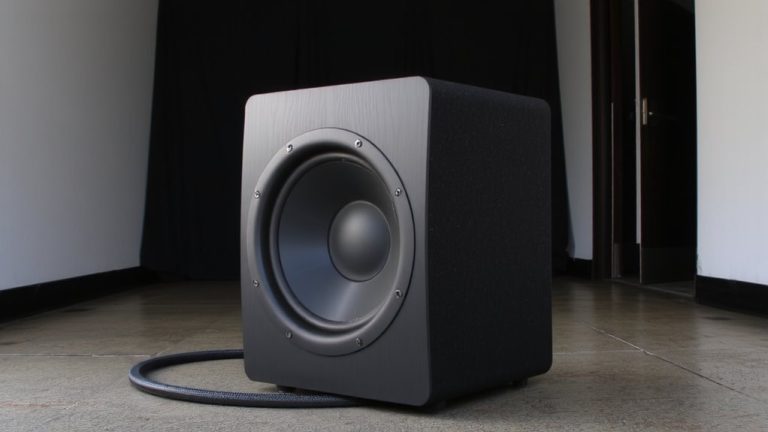
Best Placement of Subwoofer With Soundbar
Place your subwoofer front and center, aligned with your soundbar on the same vertical plane for tight, cohesive bass that anchors audio effects. Keep it 12 to 18 inches from the wall to avoid boomy, uneven output. Try the subwoofer crawl-test spots at knee level with bass-heavy tracks to find smooth, balanced response. In rooms under 200 sq ft, position it 25–33% from the front wall. Dual subwoofers help in larger spaces, especially over 400 sq ft, where room modes cause uneven bass. Use wireless models or low-profile designs to tuck it discreetly-just keep ports clear. There’s more to optimizing placement based on your room’s shape, gear setup, and listening habits.
We are supported by our audience. When you purchase through links on our site, we may earn an affiliate commission, at no extra cost for you. Learn more. Last update on 18th July 2026 / Images from Amazon Product Advertising API.
Notable Insights
- Align the subwoofer with the soundbar on the same vertical plane for tighter, more cohesive bass response.
- Keep the subwoofer 12 to 18 inches from the wall to avoid boomy bass and standing waves.
- Use the subwoofer crawl technique to find the spot with smoothest bass response in your room.
- In rooms under 200 sq ft, place the subwoofer 25–33% from the front wall for optimal integration.
- Add a second subwoofer only if seating areas have uneven bass, especially in rooms over 400 sq ft.
Front and Center: Align Subwoofer With Soundbar
While you might be tempted to stash your subwoofer in a corner for out-of-the-way placement, putting it front and center-right next to or beneath your soundbar-actually delivers tighter, more cohesive bass that locks in with the main audio channels. This ideal placement improves bass integration and sound coherence by aligning the subwoofer with soundbar on the same vertical plane, reducing phase cancellation. Your subwoofer location matters: front and center mimics a unified speaker array, boosting acoustic performance and keeping effects anchored to the screen. Experts and Delft University simulations confirm this subwoofer placement enhances timing and imaging, especially when you align subwoofer with soundbar. You’ll hear deeper lows without muddiness, and dialogue stays clear during movies or live streams. It’s not just theory-testers note tighter punch and better blend, even at reference levels. Skip the corners; go front and center for balanced, accurate bass that truly supports your setup.
Don’t Trap It Against the Wall
You’ve probably heard the advice to keep your subwoofer up front and centered with your soundbar for cleaner, more cohesive bass, but that doesn’t mean shoving it tight against the wall. Placing your subwoofer directly against a wall increases boundary reinforcement, causing bass frequencies to build up and sound boomy. To achieve ideal sound, keep it at least 12 to 18 inches away from the wall. This placement reduces standing waves and minimizes the impact of room modes, which can create uneven bass response. Forward positioning helps sound waves disperse more evenly, especially in ported subwoofers, where airflow matters. Keeping the subwoofer away from the wall guarantees cleaner output, tighter bass response, and better integration with your soundbar. Proper placement near one-third or one-fifth of the room’s length often delivers the most balanced performance across listening positions.
Use the Subwoofer Crawl to Find Perfect Placement
Often, the easiest way to nail down the ideal subwoofer placement is by flipping the setup process-just for a moment. Try the subwoofer crawl: put the sub at your primary listening position and play bass-heavy content while you move around the room. Get down to knee level-where the subwoofer will sit-and listen closely. You’re hunting for where the bass sounds best: smooth bass with no dead spots or booming. Areas with overpowering low end likely suffer from standing waves, while weak zones indicate poor response. Mark spots with balanced, tight output-this is your best place. The subwoofer crawl, backed by studies like those from Delft University, beats trial and error every time. Once you find the best place, return the sub there and fine-tune. Check subwoofer performance from multiple seats to guarantee consistent, room-filling smoothness.
Match Location to Room Size and Shape
Now that you’ve used the subwoofer crawl to zero in on where bass sounds best from your main seat, it’s time to factor in your room’s size and shape-because even the smartest placement can fall flat if it doesn’t align with your space’s acoustics. In small rooms under 200 sq ft, placing the subwoofer within 25–33% of the front wall boosts bass evenness and tames modal resonance. For rectangular rooms, the ideal placement is at one-third the length of the long wall to reduce standing waves. Square rooms are trickier-position the subwoofer mid-wall to avoid symmetrical modes that create bass nulls. Large rooms over 400 sq ft often need dual subwoofers at opposing one-third points for uniform response. Always match subwoofer placement to room size and room shape to maximize clarity and impact.
Add a Second Subwoofer Only If Needed
While a single well-placed subwoofer handles bass duties just fine in most setups, adding a second one makes sense only if you’re still hearing boomy peaks or dead spots across your seating area after fine-tuning the first. If your bass response feels uneven across listening positions, dual subwoofers can help cancel out room modes and reduce standing wave issues, especially in spaces over 400 square feet. Proper subwoofer placement-like front and rear walls or left and right thirds-boosts bass uniformity. But if your soundbar systems already deliver tight, balanced lows, add a second subwoofer only if your AV receiver supports dual sub outputs, since many don’t. Otherwise, you’ll need external amplification. Most users won’t need the extra hardware, but in challenging rooms, dual subwoofers can transform the experience with smoother, more consistent bass.
Hide Subwoofer and Cables Without Sound Tradeoffs
Where should you put your subwoofer when you want deep bass but don’t want it stealing the spotlight? You can hide it without losing performance. Place your subwoofer on the floor near the soundbar for ideal placement, keeping it 6–12 inches from walls to preserve bass clarity. Choose wireless subwoofers or low-profile models to save floor space and tuck them behind furniture cleanly. Use cable management tools like raceways or wall channels to hide cables safely-avoid sharp bends that hurt signal quality. If using a shelf or cabinet, leave 6 inches of clearance around the port. Align the subwoofer left or right of the TV for seamless integration with the soundbar.
| Solution | Benefit |
|---|---|
| Wireless subwoofers | Reduce clutter, easy placement |
| Low-profile models | Fit tight spaces, stay hidden |
| Cable management | Hide cables, maintain signal |
| Front-wall placement | Enhance bass clarity, ideal placement |
On a final note
Place your subwoofer near the front and center, aligned with the soundbar for tight bass that matches on-screen action. Avoid crammed corners-give it at least 6–12 inches from walls to prevent boomy distortion. Try the subwoofer crawl: play a bass-heavy track, crawl the room, and pick where lows sound even and punchy. Smaller rooms often need just one sub, while larger or oddly shaped spaces may benefit from a second sealed 10-inch unit, wired or wireless. Use furniture or rugs to hide boxes and route cables cleanly-just don’t trap sound. Real testers found Sonos and SVS models delivered clean output down to 25Hz, blending smoothly with soundbars like the Samsung HW-Q990D or LG S95QR.