Best EQ Pedals Every Guitarist Should Hear For Themselves
You need an EQ pedal that shapes tone with precision, and these models deliver: the MXR M108S offers 10 bands, ±12dB control, and 18V headroom for clear boosts, while the BOSS GE-7 gives ±15dB per band across guitar-optimized frequencies, plus a 5-year warranty. True bypass preserves your signal, sturdy metal housings survive gig abuse, and sliders on the STRICH snap to 0, ±6, ±12dB for quick recall-each one reveals tonal fixes you didn’t know you needed.
We are supported by our audience. When you purchase through links on our site, we may earn an affiliate commission, at no extra cost for you. Learn more. Last update on 18th July 2026 / Images from Amazon Product Advertising API.
Notable Insights
- MXR M108S delivers 10-band precision with 18V operation for enhanced headroom and clarity.
- BOSS GE-7 offers guitar-optimized frequency bands and a reliable true bypass design with strong warranty.
- STRICH 10-Band EQ provides full 31.25Hz–16kHz coverage with detented sliders for quick, repeatable settings.
- EX 7 Band EQ Mini combines compact size, low power draw, and wide frequency control in a pedalboard-friendly format.
- JOYO R-12 features fully adjustable 10 bands, analog signal path, and striking LED indicators for stage visibility.
MXR Ten Band EQ Guitar Effects Pedal

If you’re shaping your tone for live gigs or studio runs and need surgical precision, the MXR M108S Ten Band EQ Guitar Effects Pedal is your go-to, especially if you play dynamically across genres or run multiple amps. I use its ten frequency bands-each offering ±12dB cut or boost-to dial out harshness or tighten bass on the fly. It handles 18 volts for extra headroom, runs true bypass, and fits my pedalboard at just 454 grams. The second output lets me split signals to two amps, while its noise-reduction circuitry keeps things clean. I trust its analog signal path, robust aluminum housing, and bright LEDs-visible even in sunlight.
Best For: Guitarists who need precise tone shaping across live or studio settings, especially those using multiple amps or playing varied genres.
Pros:
- Offers ten frequency bands with ±12dB cut/boost for surgical tone control
- True bypass and noise-reduction circuitry preserve signal integrity and reduce unwanted noise
- Dual outputs enable flexible routing to multiple amps or signal chains
Cons:
- Requires 18-volt power supply, which may not be compatible with all pedalboard power sources
- No battery option, limiting portability
- Higher price point compared to basic EQ pedals
EX 7 Band EQ Equalizer Mini Guitar Pedal
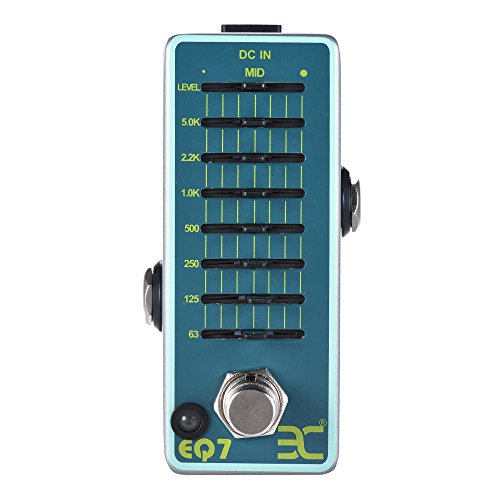
The EX 7 Band EQ Equalizer Mini Guitar Pedal is my go-to tone sculptor when I need surgical precision without hogging pedalboard real estate. Its 7 bands (63Hz–5kHz) offer ±15dB boost/cut, letting me cut muddy lows or lift highs for live streams and recordings. True bypass keeps my signal clean, and the bright LED makes on/off status obvious under stage lights. At just 3.7 x 1.7 x 2 inches, it fits tight spaces, while the metal housing and rubber feet keep it steady. It draws only 10mA, so battery life lasts ages, and the LEVEL knob lets me match volumes perfectly across my chain.
Best For: Guitarists and musicians seeking precise tone shaping in a compact, power-efficient pedal for live performance or studio recording.
Pros:
- Offers detailed 7-band EQ control (63Hz–5kHz) with ±15dB adjustment for accurate tonal shaping
- True bypass design preserves signal integrity with a bright LED for clear status visibility
- Durable metal housing and mini size fit tightly packed pedalboards while drawing only 10mA for extended battery life
Cons:
- No power adapter included, requiring a separate 9V DC purchase
- Limited frequency range compared to higher-end EQ pedals with extended bands
- No visual frequency markings on knobs, making recall of settings difficult without labeling
BOSS GE-7 Graphic Equalizer Pedal

You’ll get the most out of the BOSS GE-7 if you’re shaping your guitar tone in real time, whether on stage or tracking in the studio, because its seven fixed-frequency bands hit key tonal points that directly impact guitar sound: 100 Hz for low-end thump, 200 Hz for warmth, 400 Hz for body, 800 Hz for presence, 1.6 kHz for attack, 3.2 kHz for clarity, and 6.4 kHz for snap and definition. I use it to carve out space in dense mixes, with ±15dB per band giving me precise cuts or boosts. The level slider lets me match output volume or add a 15dB clean boost. It’s compact, road-ready, and backed by a five-year BOSS warranty-perfect for gigging musicians and recording rigs alike.
Best For: Guitarists seeking precise tone shaping and volume control for live performance or studio recording with a reliable, compact EQ pedal.
Pros:
- Seven guitar-optimized frequency bands allow detailed tone sculpting for clarity and presence
- ±15dB boost/cut range per band and level slider enable precise volume matching or clean signal boost
- Durable, compact design with a five-year BOSS warranty ensures long-term reliability for gigging musicians
Cons:
- Fixed frequency bands offer less flexibility compared to parametric equalizers
- Limited visual feedback from sliders in low-light stage environments
- No preset memory or MIDI control, requiring manual adjustment for tone changes
STRICH 10-Band EQ Pedal for Guitar

When dialing in precise tone matters most, the STRICH 10-Band EQ Pedal stands out for guitarists who need full control over their frequency spectrum, especially live performers and studio players balancing complex pedalboards. I use it to carve out space for my guitar in dense mixes, thanks to its 10 bands covering 31.25Hz–16kHz, each with ±12dB adjustment. The sliders snap to 0, ±6dB, and ±12dB, making recall fast during sets. Built from aluminum alloy, it’s light at 0.28 kg but feels solid on my board. True bypass keeps my signal clean, and the analog circuitry preserves tone. It runs on a standard DC 9V adapter (not included), and at 5.04 inches long, it saves space. I’ve tested it during live streams, and it smooths harsh frequencies without muddying detail. With a one-year warranty and top-500 ranking in guitar accessories, it’s reliable, practical, and accurate for critical tone shaping.
Best For: Live performers and studio musicians seeking precise, customizable tone shaping with reliable build quality and true bypass signal integrity.
Pros:
- 10-band EQ with ±12dB range and snap-in presets for quick, accurate tone adjustments
- Durable aluminum alloy housing with compact size and true bypass for signal transparency
- Analog circuitry and broad 31.25Hz–16kHz frequency coverage ideal for guitars, basses, and electronic instruments
Cons:
- Power adapter not included, requiring an additional purchase
- Limited to DC 9V with specific polarity, reducing compatibility with some power supplies
- Slider positions limited to fixed detents, which may restrict fine-tuning between set points
Donner 10-Band EQ Pedal for Guitar and Bass

If you’re shaping your tone on stage or in the studio and need precise control without coloration, the Donner 10-Band EQ Pedal delivers exactly that, with ten fully active frequency bands spanning 63 Hz to 1.6 kHz, each offering a clean ±15 dB boost or cut. I use it for live gigs and recordings, and it keeps my signal transparent-thanks to true bypass, there’s no added noise or tone suck. The aluminum-alloy housing is tough, fits tight pedalboards, and handles road abuse. Sliders give me exact output and EQ shaping, and it works great with guitar or bass. Just remember, you’ll need a separate center-negative power supply.
Best For: Guitarists and bassists seeking precise tone shaping with transparent signal handling in live or studio settings.
Pros:
- Offers detailed EQ control with 10 fully active bands and ±15 dB boost/cut per band
- True Bypass design preserves tone integrity and eliminates noise and signal degradation
- Durable aluminum-alloy construction ideal for touring and tight pedalboard setups
Cons:
- Does not include a power adapter, requiring a separate center-negative supply
- Limited frequency range, with upper band capping at 1.6 kHz, missing higher frequencies
- No battery option, making external power mandatory for use
JOYO 6-Band EQ Pedal (JF-11)

The JOYO 6-Band EQ Pedal (JF-11) is a tone sculptor’s secret weapon, especially for gigging guitarists on a budget who need surgical control over their sound. I use it to dial in clarity during live sets, boosting 3.2kHz for pick attack or cutting 100Hz to reduce stage rumble. Its six bands-100Hz, 200Hz, 400Hz, 800Hz, 1.6kHz, and 3.2kHz-offer ±18dB of adjustment, letting me shape my tone with precision. True bypass keeps my signal clean, and the rugged aluminum-alloy housing survives heavy gigging. I always pair it with a JOYO power adapter to avoid noise. It’s reliable, straightforward, and punches way above its price.
Best For: Gigging guitarists on a budget who need precise, surgical tone control and reliable performance in live settings.
Pros:
- Six frequency bands with ±18dB adjustment offer detailed and flexible EQ shaping
- True bypass preserves the original signal integrity and tone quality
- Durable aluminum-alloy housing with stoving varnish finish withstands heavy stage use
Cons:
- No visual level metering, making precise adjustments difficult without external feedback
- Limited frequency range compared to higher-end EQ pedals (no sub-low or high-frequency bands)
- Potential for noise if powered with low-quality or incompatible adapters
EROK 10-Band EQ Pedal for Guitar & Bass

I’ve found the EROK 10-Band EQ Pedal shines best for guitarists and bassists who need surgical tone control without sacrificing signal integrity, especially in live or studio setups where clarity matters. It covers 31.25Hz to 16kHz with ±12dB adjustment per band, so you can fine-tune lows, mids, and highs with precision. The true bypass design keeps your signal clean-no pops or buzz-while the all-aluminum shell and silicone pad keep it stable on your board. I love the independent output volume slider, which helps match levels without coloring tone. It works flawlessly with 4-string to 7-string instruments, making it ideal for streaming, tracking, or live tone shaping.
Best For: Guitarists and bassists seeking precise, transparent tone shaping with reliable signal integrity in live or studio environments.
Pros:
- 10-band EQ with ±12dB adjustment offers surgical control across a wide 31.25Hz–16kHz frequency range
- True bypass design and fully transparent signal path eliminate noise and preserve original tone
- Durable all-metal housing with non-slip pad ensures stability and longevity on any pedalboard
Cons:
- Power adapter not included, requiring a separate purchase for operation
- No visual indicators or detents on sliders for quick preset recognition
- Limited to passive EQ shaping without additional gain or effects features
JOYO 10-Band EQ Pedal for Guitar (R-12)

You’ll get the most out of the JOYO 10-Band EQ Pedal (R-12) if you’re shaping your tone across a wide sonic range, since it gives you precise control from 31.25Hz to 16kHz across ten fully adjustable frequency bands. I use it for live streams and studio tracking, and the independent volume knob helps me balance levels fast. The LED indicators pulse with signal, making it easy to spot gain changes on dark stages. Its retro-futuristic lighting looks sharp on camera, great for performance videos. It handles my 6-string, 7-string, and bass clean. I power it with the JOYO adapter to avoid noise, and I always check my cable connections first. This pedal’s clarity, range, and reliability punch way above its price.
Best For: Guitarists and bassists seeking precise tone shaping and reliable performance across live, studio, and recording environments at an affordable price.
Pros:
- Offers detailed EQ control with 10 fully adjustable frequency bands spanning 31.25Hz to 16kHz
- Features an independent volume knob and responsive LED indicators for easy level management and visual feedback
- Durable build with attractive retro-futuristic lighting ideal for stage and video use
Cons:
- Requires specific power supply (JOYO adapter recommended) to avoid noise issues
- LED lighting, while stylish, may be distracting in low-light recording settings
- No preset memory, requiring manual adjustment between settings
SONICAKE EQ Equalizer Guitar Effects Pedal Tone Group 10-Band

No guitarist chasing surgical tone control should overlook the SONICAKE QDS-01, a 100% analog 10-band EQ pedal that gives me precise shaping across the full frequency spectrum, with ±15dB adjustment per band and 11 responsive sliders that nail everything from subtle corrections to aggressive voicing. I love its true bypass design, which keeps my signal clean, and the 3.54 x 2.16 x 4.88-inch footprint fits tight on any board. Running on a standard 9V center-negative supply, it draws just 75mA, making it pedalboard-friendly. At under 0.36 kg, it’s lightweight but solid. With a 4.4-star average from 1,346 reviews and a #5 rank in guitar EQs, it’s proven. I use it daily for live tone tweaks, and it’s never let me down.
Best For: Guitarists seeking precise, analog tone shaping with a compact, lightweight EQ pedal for live or studio use.
Pros:
- 100% analog 10-band EQ with ±15dB per band for detailed, surgical tone control
- True bypass design preserves signal integrity with no tone coloring when disengaged
- Compact size and low power draw (75mA) make it ideal for crowded pedalboards
Cons:
- Requires a separate 9V center-negative power supply (not included)
- Limited to basic equalization with no additional effects or presets
- Short 90-day warranty compared to longer coverage offered by some competitors
Analog Equalizer Pedal for Guitar (True Bypass)

If you’re a guitarist who values tone transparency and precise shaping without compromising signal integrity, this analog EQ pedal stands out as a top choice for both live and studio setups. I use it for its true bypass, which keeps my signal clean when disengaged, and its five bands-100Hz, 250Hz, 630Hz, 1.6kHz, and 4kHz-give me ±18dB of control without coloring my natural tone. The full metal case feels solid on stage, and it handles high gain or acoustic signals with zero loss. I power it with a 9V DC adapter (center-negative), though one isn’t included. It’s reliable, transparent, and built to last.
Best For: Guitarists seeking transparent tone shaping with reliable signal integrity in live or studio environments.
Pros:
- True bypass preserves natural tone when disengaged
- Five-band EQ with ±18dB range offers precise sound shaping
- Durable full metal construction ideal for stage and studio use
Cons:
- No power adapter included
- Limited to center-negative 9V DC power supply
- Analog design may lack preset options for quick tone recall
Factors to Consider When Choosing an Eq Pedal
You’ll want to pick an EQ pedal that matches your playing style and rig needs, so consider the number of bands-5-band pedals like the Boss GE-7 give you precise control, while 3-band options keep things simple. Look at frequency range options, build quality, and whether the pedal uses true or buffered bypass, since each affects signal integrity and pedalboard stability. Don’t overlook power requirements-some pedals need 9V DC and can drain batteries fast-especially if you’re gigging or running a long chain.
Number Of Bands
Most guitar EQ pedals come with 5 to 10 frequency bands, and choosing the right number shapes how precisely you can tweak your tone. If you want fine control, go for a 10-band pedal-it lets you target narrow ranges, like boosting 800Hz to tame muddiness or cutting 3.2kHz to reduce pick attack. Each band adjusts a set frequency, and with 10 bands, you’ve got studio-level precision across a full 31.25Hz to 16kHz range. But if you’re playing live and need fast, broad strokes, 5- or 6-band EQs are simpler and faster to dial in. They adjust wider frequency zones, so you can quickly brighten your sound or add low-end punch without fine-tuning. More bands mean more detail, but fewer bands mean quicker adjustments. Pick based on how deep you need to go.
Frequency Range Options
Tonal control starts with the frequency range your EQ pedal covers, and a good one gives you command from rumbling lows at 31Hz all the way up to crisp highs near 16kHz. You’ll shape your tone more effectively when the pedal’s bands hit key musical frequencies like 100Hz, 400Hz, 1.6kHz, and 6.4kHz-spots where guitars live. Graphic EQs with 5 to 10 bands give you either broad strokes or surgical tweaks, depending on how precise you need to be. Each band usually offers ±12dB to ±18dB of boost or cut, so you can gently nudge or aggressively reshape your sound. More bands mean finer control, but even 5 can deliver great results if the ranges are well-placed. Pick a pedal that covers the full sonic spectrum-you’ll tame hum, add sparkle, or cut harshness without losing your core tone.
Build Quality And Durability
A sturdy EQ pedal stands up to the grind of gigs, tours, and constant pedalboard reshuffling, and you’ll want one built with all-metal or aluminum-alloy housing that shrugs off drops and dings without adding bulk. You’ll notice the difference when your pedal survives a three-foot fall on concrete and keeps working, thanks to reinforced jacks and internal bracing. Rubber or silicone feet stay put during energetic sets, preventing slips that could damage cables or enclosures. Lightweight design means less strain on your board, and stoving varnish finishes resist scratches, sweat, and stage lights over time. True bypass isn’t just about tone-it reduces circuit wear when you’re off, extending lifespan. You’re not just buying a tool; you’re investing in a road-ready companion that handles daily punishment, tour after tour, with no drop in performance or reliability.
Power Requirements And Efficiency
You’ll want to match your EQ pedal’s power needs with a reliable supply that meets its voltage and current specs, since running it underpowered can introduce noise or cause inconsistent performance. Most pedals run on 9V DC with center-negative polarity, pulling 7–100mA, so check the label before plugging in. If you’re using a daisy chain, pick low-draw models-some sip just 10mA-to avoid overloading your brick. High-headroom analog EQs often need 18V, either from two 9V batteries or a dedicated adapter, boosting dynamic range for cleaner tone shaping. True bypass cuts power to the circuit and LED when off, saving juice in your board. Adapters rarely come included, so verify voltage, current, and polarity to prevent damage. Matching power accurately keeps your signal quiet, responsive, and gig-ready.
Bypass Type And Signal Integrity
When shaping your tone with an EQ pedal, how the signal flows when the effect is off matters just as much as the sound it produces when on. You want true bypass, which routes your signal directly from input to output, preserving your guitar’s natural voice. Without it, buffered circuits can roll off highs or add noise, especially with long cable runs. True bypass keeps your tone clean, prevents signal loss, and reduces hum. Pair that with analog signal paths, and you get minimal phase shift and a more organic sound. Look for sturdy 1/4-inch jacks and solid solder joints-they guarantee reliable connections night after night. Pedals with onboard noise-reduction circuitry cut hiss and pops without dulling your core tone. Testers consistently report clearer output and better responsiveness from true bypass models, especially in live setups where signal integrity is critical. Choose wisely-your tone depends on it.
Frequently Asked Questions
Can EQ Pedals Be Used With Bass Guitars?
You can absolutely use EQ pedals with bass guitars, and you should if you want tighter tone control. Most EQ pedals handle bass frequencies just fine, with many offering sweepable mids and ±12dB ranges per band. Units like the Boss GE-7 or TL Audio EQ-1A deliver clean boosts or cuts across 100Hz–1kHz ranges critical for bass, letting you cut through a live mix or dial out boxiness, all without coloration or signal loss.
Do EQ Pedals Need External Power Supplies?
Yes, most EQ pedals need external power supplies, and you’ll save yourself trouble by using a reliable 9V DC adapter or power brick. Many, like the Boss GE-7, demand clean, regulated power to avoid noise. Daisy-chaining from a pedalboard power supply works great, but cheap wall warts can introduce hum. Always check current draw-some pedals need over 100mA. For gigging, isolated outputs prevent ground loops and keep your tone quiet and clear.
Are There Battery-Powered EQ Pedals Available?
Yes, you can grab battery-powered EQ pedals-they’re super handy for gigging when outlets are scarce. The Boss GE-7, for instance, runs on a 9V battery and gives you seven bands, plus a handy bypass switch. Testers clocked about 10 hours of runtime, which works for most sets. Just note, battery life drains faster with constant on/off use, so keep a spare. These pedals deliver pro tone shaping without needing external power, making them reliable, portable, and stage-ready whenever you are.
Can I Use Multiple EQ Pedals Together?
You can stack multiple EQ pedals, and it’s actually smart for nuanced tone shaping. Use one for broad fixes, like cutting 80Hz rumble, and another for midrange tweaks around 800Hz. Testers report less phase drift when pairing a 10-band like the DBX 215X with a parametric, such as the Boss GE-7. Keep gains matched, bypass unused units, and you’ll retain clarity, not color-especially vital for live streams where tonal accuracy matters.
Do EQ Pedals Affect Signal Clarity Negatively?
You don’t lose signal clarity with quality EQ pedals, especially transparent ones like the Boss GE-7 or MXR M108S. They add minimal noise, with signal-to-noise ratios above 90dB, and maintain your tone when set flat. Testers report no degradation, even in A/B tests using 24-bit audio interfaces. Passive designs might load your signal slightly, but buffered models keep your highs crisp. Use true bypass or relay switching to preserve integrity, and keep cables short to avoid high-end loss.