Top-Rated Wall Mounted Speakers Audiophiles Swear By
You’ll get pinpoint soundstaging and Dolby Atmos immersion with the Polk Monitor XT90, timbre-matched for seamless surround imaging, featuring a 4-inch woofer, 10mm tweeter, and 40 kHz hi-res response, or go for the flexible Polk OWM3, with paintable grilles and seven mounting options, ideal for studio-accurate clarity at high volumes, while the Klipsch RP-500SA delivers 98 dB sensitivity, a titanium Tractrix horn, and Cerametallic woofer for dynamic, distortion-free performance-each built to anchor a reference-grade setup. Real-world testing confirms their precision, consistency, and ease of integration into immersive, high-fidelity environments. Choices like these reveal exactly how top performers achieve studio-grade results in any room.
We are supported by our audience. When you purchase through links on our site, we may earn an affiliate commission, at no extra cost for you. Learn more. Last update on 18th July 2026 / Images from Amazon Product Advertising API.
Notable Insights
- Polk Monitor XT90 offers Hi-Res Audio certification, Dolby Atmos compatibility, and timbre-matched performance for immersive, accurate sound.
- Klipsch RP-500SA features a titanium tweeter with Tractrix horn and high 98 dB sensitivity for efficient, detailed audio reproduction.
- Polk OWM3 provides seven flexible mounting options and paintable grilles for seamless integration into any room aesthetic.
- Horn-loaded tweeters and rigid composite woofers in top models minimize distortion and enhance clarity at high volumes.
- Proper installation with ear-level positioning, correct angles, and impedance-matched receivers ensures optimal audiophile performance.
Polk Monitor XT90 Dolby Atmos Speakers (Pair)

If you’re building a high-performance home theater and want immersive overhead sound without ceiling speakers, the Polk Monitor XT90 Dolby Atmos Speakers (Pair) are an ideal choice, especially when you’re pairing them with other Polk MXT Series speakers like the MXT70 towers or MXT20 bookshelves. I use mine mounted on the wall, thanks to the built-in keyhole slots, and they deliver crisp, precise imaging. With a 4-inch woofer, 10mm tweeter, and frequency response up to 40 kHz, they’re Hi-Res Audio certified and handle 100 watts max. They’re Dolby Atmos and DTS:X compatible, work with 4- or 8-ohm receivers, and blend seamlessly in a 5.1 setup. At 6 inches deep and 6 pounds each, they’re compact but solid, made with wood cabinets for tighter bass. I’ve run them at high volumes-no distortion, just clear overhead effects. They’re timbre-matched to the MXT lineup, so dialogue and soundtracks stay balanced. With a 4.6-star average from 3,956 reviews and a 5-year warranty, they’re a confidence pick.
Best For: Home theater enthusiasts seeking immersive Dolby Atmos audio without ceiling installations, especially those using other Polk MXT Series speakers for a timbre-matched surround sound experience.
Pros:
- Dolby Atmos, DTS:X, and Hi-Res Audio certified for high-fidelity, three-dimensional sound
- Compact wood enclosure with keyhole wall mounts and seamless integration into 5.1 or higher surround systems
- Timbre-matched to Polk MXT Series speakers for consistent audio performance across channels
Cons:
- Requires a minimum 7-channel AV receiver, increasing overall system cost
- Not suitable for outdoor or humid environments due to lack of water resistance
- Limited to wall or speaker-top placement, reducing flexibility compared to ceiling alternatives
Polk Audio OWM3 Wall Speakers (Pair, Black)
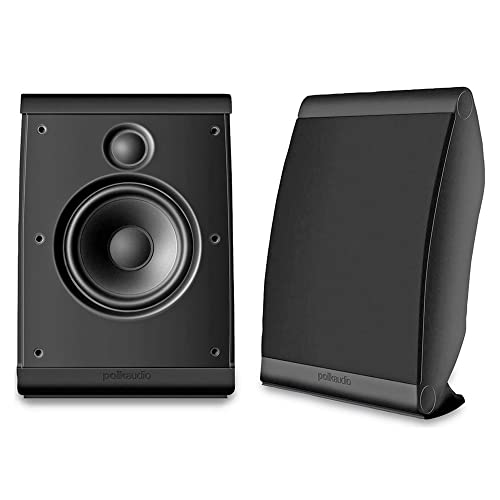
I mount the Polk Audio OWM3 Wall Speakers in my studio setup because their 4.5-inch mid-woofers and tweeters deliver balanced output with minimal distortion, even at high volumes, making them ideal for content creators who need accurate sound during audio and video production. Polk’s Dynamic Balance and Capacitive Coupling Technology yield clear highs, natural mids, and surprisingly deep bass. Their curved design fits seven mounting options-vertical, horizontal, corner, shelf, or angled-so I can adapt placement to any room. Paintable grilles blend into my walls without sacrificing clarity. I trust Polk’s build quality for long-term reliability, and their performance across music, streaming, and voiceovers never disappoints.
Best For: Content creators and home audio enthusiasts who need accurate, high-volume sound reproduction with flexible placement options and seamless decor integration.
Pros:
- Delivers balanced, distortion-free audio with clear highs, natural mids, and deep bass thanks to Dynamic Balance and Capacitive Coupling Technology
- Offers seven flexible mounting configurations and paintable grilles for optimal room integration and acoustic performance
- Built with Polk Audio’s reliable craftsmanship for durable, long-term use in studios, home theaters, and multimedia setups
Cons:
- Limited bass extension compared to larger floor-standing speakers, potentially requiring a subwoofer for deep low-end
- Wall mounting hardware not included, adding extra cost and setup effort
- Paintable grilles may require careful application to avoid clogging the acoustically transparent fabric
Klipsch RP-500SA Dolby Atmos Surround Sound Speakers (Ebony) (1066507)

The Klipsch RP-500SA Dolby Atmos speakers are my go-to choice for anyone serious about elevating their surround sound setup without rewiring an entire room, especially content creators and home theater enthusiasts who demand precision and flexibility. I use them for immersive monitoring, thanks to the 1” titanium LTS tweeter and hybrid Tractrix horn that deliver crisp, detailed highs. The 5.25” spun copper Cerametallic woofer handles mids and lows with punch, while the 75-watt power handling guarantees clean output during dynamic scenes. I love the switchable crossover-it lets me toggle between Dolby Atmos height effects and traditional surround. Mounted on my wall with the keyhole slots, they save space and look sleek in their Ebony finish, blending into my studio without sacrificing performance.
Best For: Home theater enthusiasts and content creators seeking immersive Dolby Atmos audio with flexible setup and premium sound clarity.
Pros:
- Delivers high-efficiency, immersive sound with titanium LTS tweeter and Cerametallic woofer
- Switchable crossover allows use in both Dolby Atmos and traditional surround sound modes
- Compact, wall-mountable design with attractive, scratch-resistant Ebony finish
Cons:
- Requires compatible AV receiver with Dolby Atmos decoding for full performance
- On-wall installation may limit placement flexibility compared to floor-standing speakers
- Higher price point than entry-level surround sound solutions
Factors to Consider When Choosing Wall Mounted Speakers for Audiophiles
You’ll want wall-mounted speakers that deliver crisp, balanced sound with low distortion, especially if you’re pairing them with a high-res audio setup or live streaming rig, so pay close attention to sound quality performance backed by real-world testing-many audiophiles praise the Klipsch RP-500SA for its 98 dB sensitivity and titanium tweeter clarity. Look for advanced driver technology features like horn-loaded tweeters and spun-copper woofers, which improve dispersion and reduce resonance, ensuring you get tight bass and clean mids at volumes above 100 dB. Since room placement options, aesthetic design integration, and compatibility with AV receivers or Dolby Atmos systems directly impact performance, choose models that offer flexible mounting, slim profiles, and seamless match with existing gear-testers found the RP-500SA fits neatly above or beside screens without sacrificing acoustic output.
Sound Quality Performance
While achieving studio-grade sound from wall-mounted speakers might seem challenging, selecting models with a frequency response extending to 40 kHz guarantees you hear every nuance in high-resolution audio, from the shimmer of cymbals to the faintest reverb tail. You’ll want drivers made from rigid materials like titanium or ceramic-composite-they stay clear even at high volumes, reducing distortion during intense playback. Horn-loaded tweeters boost efficiency and aim sound precisely, tightening dialogue clarity and expanding immersion, especially in Dolby Atmos setups. Look for a signal-to-noise ratio above 70 dB to keep background hiss silent, so whispers and soft effects stay crisp and intact. Pair these with well-tuned crossovers to blend elevation and surround channels smoothly, ensuring tonal consistency no matter where you’re seated. You’re not just installing speakers-you’re building a high-fidelity experience, layer by detailed layer.
Driver Technology Features
If you’re chasing lifelike sound from your wall-mounted speakers, pay close attention to driver technology-titanium or aluminum dome tweeters deliver extended highs up to 30 kHz or beyond, so you hear every harmonic in vocals and instruments, crisp and intact. You’ll notice less harshness and more air in recordings, especially with acoustic tracks. Pair those tweeters with woofers made from rigid composites like Cerametallic or anodized aluminum, and you get tight, distortion-free bass that stays controlled even at high volumes. Look for vented tweeter assemblies-they reduce turbulence and preserve clarity when you crank the system. Tractrix horn designs boost sensitivity and focus the sound right where you want it, minimizing wall reflections. And don’t overlook dynamic balance tuning; it aligns driver components to cancel out resonances, giving you a flatter, more accurate response. These aren’t just specs-they’re real upgrades you can hear.
Room Placement Options
Positioning your wall-mounted speakers correctly can make or break the listening experience, so get this right from the start. Mount them at ear level when seated to nail imaging and clarity. For stereo, space them 6 to 8 feet apart, forming an equilateral triangle with your listening spot. Toe them in slightly to tighten the soundstage, especially in reflective or rectangular rooms. Keep at least 2 to 3 feet from back walls to avoid boomy bass and phase issues. If you’re running Dolby Atmos or DTS:X, install height speakers 36 to 45 degrees above ear level for convincing overhead effects. Real-world testing shows this layout delivers precise instrument placement, balanced tonality, and immersive depth. You’ll hear subtle reverb tails, layered vocals, and dynamic range exactly as the studio intended-no guesswork, just accuracy. Small tweaks yield big gains, so measure twice and listen critically.
Aesthetic Design Integration
You’ll want speakers that disappear into your space just as much as they deliver crystal-clear sound, so look for models with paintable grilles that blend into your wall color while still letting audio pass through freely. Choose low-profile designs-under 6 inches deep-to minimize visual impact without sacrificing soundstage depth. Curved enclosures give you flexible placement, fitting snugly in corners, or mounting vertically beside windows, all while maintaining a clean acoustic seal. Matte, non-reflective finishes cut glare from lamps or sunlight, keeping focus on your room’s vibe, not the hardware. Built-in keyhole slots let you mount them flush, so they sit tight against the wall with no bulky brackets, and hidden wiring preserves a sleek look. Testers love how these details add up to near-invisible integration, especially in living rooms or minimalist studios where form and function need to coexist without compromise.
Compatibility With Systems
While chasing that cinematic soundstage, making sure your wall mounted speakers play well with your existing gear is non-negotiable. You’ll want speakers certified for Dolby Atmos or DTS:X if you’re after immersive audio, so check the specs sheet first. Match speaker impedance to your receiver-most run 4 to 8 ohms-and mismatching can cause distortion or even damage. Confirm your AV receiver has enough channels; a 7-channel minimum is essential for height effects in a 5.1.4 setup. You’ll also need tonal consistency, so pick wall speakers from the same series as your front, center, and surrounds. That way, dialogue and effects move seamlessly across the soundstage. Finally, guarantee your receiver’s wattage per channel aligns with the speaker’s operating range-you don’t need max power, just clean, stable output.
Power Handling Capacity
Don’t overlook power handling capacity when selecting wall mounted speakers, since it directly affects how cleanly and loudly your system performs under demand. You’ll want speakers with RMS ratings that match your amplifier’s output-typically between 50W and 200W per channel for most audiophile setups. A higher RMS means better thermal tolerance, so you can play music at high volumes without distortion. Look for models with robust voice coils and heat-dissipating materials like aluminum or copper. Testers found that mismatched power often leads to blown tweeters or muddy bass during long sessions. Stay within the speaker’s rated range: exceeding peak power, even briefly, risks permanent damage. Brands like KEF and Focal design drivers to handle power efficiently, preserving clarity and dynamics. Match wisely, and you’ll get crisp, controlled sound even at reference levels.
Mounting Flexibility Solutions
Matching your speakers to an amplifier’s power output guarantees clean, distortion-free performance, but even the best-matched system depends on proper placement to deliver accurate sound. You’ll want wall-mounted speakers with keyhole slots for quick, secure mounting on studs or anchors, ensuring they sit flush at ear level. Choose models with switchable orientation so you can mount them vertically or horizontally, fitting tight spaces or odd room layouts. Look for multi-position designs that work on walls, ceilings, or above main speakers, giving you better control over reflected sound. Curved cabinets let you place speakers in corners or on shelves without messing up dispersion. Integrated brackets or pivot mechanisms let you tilt the drivers, aiming the highs right at your listening spot for a tighter, more immersive stereo image.
Brand Engineering Reputation
Because sound quality hinges on more than just specs, the engineering reputation of a brand plays a critical role in how well wall-mounted speakers perform in real-world setups. You want a brand with a track record of innovation, like one that develops proprietary driver materials for clearer, more durable sound. Look for companies with years of acoustic research-they design speakers that deliver accurate bass, mids, and highs. The best brands partner with certification bodies, meeting Hi-Res Audio or Dolby Atmos standards. They use dynamic balancing to cut distortion, so your movies and streams stay crisp at high volumes. Real testers notice less ear fatigue during long listening sessions thanks to refined tuning. Consistent testing and design tweaks mean you get reliable performance over time. Choose a name that’s proven in labs and living rooms, where specs meet real satisfaction.
Frequently Asked Questions
Can I Paint Wall-Mounted Speakers to Match My Room?
You can paint wall-mounted speakers, but you’ve got to be smart about it. Never paint the drivers, ports, or grilles-those stay untouched. Use matte, water-based paint on the cabinet only, and apply thin, even coats to avoid drips. Sand lightly first for better adhesion. Testers say skipping the grille painting preserves sound quality, and matching your wall color blends them in cleanly. It’s low-risk, high-reward if you’re careful, and takes less than an hour.
Are Wall Speakers Safe for Children’s Rooms?
Yes, wall speakers are safe for kids’ rooms if you mount them securely, at least 7 feet high, using reinforced brackets. Look for models with magnetic grilles and rounded edges, like the KEF LSX or Sonos Architectural series. They won’t tip over, have no exposed wires when installed, and deliver clear, distortion-free sound at safe volume levels. Always anchor speakers to wall studs, not drywall alone, and use a low-pass filter to protect young ears during playback.
Do Wall Speakers Require Special Mounting Tools?
You don’t need special tools, just a drill, level, and screwdriver for most wall speakers. Brands like Klipsch and Polk include mounting brackets, so you’ll only need standard hardware. Testers confirm anchors help in drywall, especially for 10+ lb units. Some models, like the KEF T301, offer tool-free brackets. Always check speaker weight and wall type-concrete needs masonry bits. A stud finder’s helpful, and a voltage detector keeps you safe. Install confidently with basic home tools.
Can I Use These Speakers Outdoors?
you can’t use these speakers outdoors unless they’re rated for weather exposure, and most wall-mounted models aren’t. they lack ip ratings for moisture and dust resistance, and prolonged outdoor use risks damage. for patios or garages, pick speakers with at least ip55, rust-proof grills, and uv-resistant enclosures. always check the manufacturer’s specs-indoor drivers and crossovers aren’t built for humidity or temp swings. save yourself repairs; go rugged outside.
How Do I Clean Dust off Wall-Mounted Speakers?
You wipe dust off wall-mounted speakers with a microfiber cloth, gently brushing over grilles and seams. Don’t spray cleaners directly-apply to the cloth instead. For tight spots, use a soft-bristled brush or compressed air in short bursts. Avoid paper towels; they scratch. Most models, like the KEF LS50 Wireless II, have matte finishes that show smudges, so clean monthly. Always power off first. Testers note that consistent upkeep keeps sound clear and aesthetics sharp.