Best Vocal Harmony Pedals That Elevate Your Singing Instantly
You get instant vocal depth with pedals like the FLAMMA FV04, delivering 11 harmony modes, dual mic/guitar inputs, and separate XLR outputs for clean live or streaming setups. The TC Helicon Harmony Singer locks onto guitar-chord harmonies in real time, while the BOSS VE-22 adds pitch correction, reverb, and doubling in a compact 3.5 x 5.5-inch chassis. Electro-Harmonix Voice Box offers dual harmonies with natural pitch bends, and Zoom V3 doubles as a 32-bit USB interface. There’s more where that came from.
We are supported by our audience. When you purchase through links on our site, we may earn an affiliate commission, at no extra cost for you. Learn more. Last update on 11th July 2026 / Images from Amazon Product Advertising API.
Notable Insights
- Choose pedals with real-time harmony generation and low latency for instant vocal enhancement.
- Prioritize models with built-in pitch correction to keep vocals perfectly in tune during live performances.
- Opt for units with flexible I/O, including XLR outputs and phantom power for professional sound setups.
- Select harmony pedals that sync with guitar or keyboard input to generate musically accurate harmonies automatically.
- Look for intuitive controls and preset management to switch effects seamlessly without interrupting your performance.
FLAMMA Vocal Harmony Pedal with Reverb (FV04)

If you’re a solo performer or small ensemble vocalist juggling live harmonies and guitar backing, the FLAMMA FV04 is the pedal that keeps both in lockstep without breaking a sweat, and I’ve found it’s especially effective when you need lush vocal layers and clean reverb in real time. I use it with my condenser mic and acoustic guitar, and the dual inputs handle both cleanly-plus, the 48V phantom power means I skip extra boxes. The 11 harmony modes shift smoothly between major and minor keys across 12 pitches, and I route vocals and guitar separately to my PA using the individual outputs. Its metal chassis survives gig after gig, and the 9V adapter powers it reliably.
Best For: Solo performers and small ensemble vocalists who need real-time vocal harmonies, guitar accompaniment, and professional-grade signal processing in live or studio settings.
Pros:
- Offers 11 harmony modes with seamless major/minor scale transitions across 12 pitches for rich, adaptive vocal layering
- Dual mic and guitar inputs with dedicated processing and 48V phantom power support for condenser microphones
- Individual outputs for flexible routing to PA systems or audio interfaces, housed in a durable metal chassis
Cons:
- Requires a 9V 500mA adapter (included) with no battery option for portable use
- Harmony effect quality may vary depending on vocal precision and input signal clarity
- Limited to preset harmony structures without customizable interval selection
TC Helicon Harmony Singer Vocal Effects Stompbox

I rely on the TC Helicon Harmony Singer when I need rich, real-time vocal harmonies that lock perfectly with my guitar chords-this pedal’s ideal for solo performers and live streamers who want studio-quality backing vocals without extra musicians. It generates one to two harmonies triggered by my guitar’s chord signals, sounding natural every time. I use momentary and latched modes to trigger harmonies on demand. The built-in reverb offers plate, hall, and room styles, adding depth fast. Adaptive Tone automatically adjusts EQ, compression, de-essing, and gating, so my voice always cuts through cleanly. Setup takes seconds, and the intuitive layout means I stay focused on performing, not tweaking.
Best For: Solo performers and live streamers seeking studio-quality, real-time vocal harmonies seamlessly synced to guitar chords without additional backing vocalists.
Pros:
- Generates natural-sounding vocal harmonies in real time using guitar chord input for accurate pitch matching
- Offers momentary and latched harmony activation modes for flexible, on-demand performance control
- Features Adaptive Tone technology that automatically optimizes EQ, compression, de-essing, and gating for clear, professional vocal output
Cons:
- Harmony generation relies heavily on clean guitar signal input, which can cause tracking issues with complex or noisy chords
- Limited to one or two harmony voices, which may not suffice for rich, multi-layered vocal arrangements
- Built-in reverb options, while useful, lack advanced customization for users seeking tailored ambience effects
BOSS VE-22 Vocal Performer Multi-Effects Processor

You’ll get the most out of the BOSS VE-22 Vocal Performer if you’re a singer who regularly moves between live stages, recording sessions, and livestream setups, since it packs studio-grade effects into a compact pedal that fits in a gig bag. I use it daily for streams, and the built-in compressor, EQ, delay, and reverb keep my vocals clear and polished. The auto-pitch correction is subtle or dramatic, depending on the song, and I love layering harmonies with its doubling and harmony functions. Effects like lo-fi, radio, and ring modulation add creative flair without sounding gimmicky. At 3.5 x 5.5 inches, it’s pedalboard-friendly, and the XLR + 1/4″ outputs connect straight to mixers or audio interfaces-no extra gear needed.
Best For: Singers and content creators who need a portable, all-in-one vocal effects processor for live performance, recording, and livestreaming.
Pros:
- Combines studio-quality effects like compression, EQ, reverb, and delay in a compact, pedalboard-friendly design
- Offers versatile pitch correction, harmony, and doubling tools for both natural and creative vocal processing
- Direct connectivity via XLR and 1/4″ outputs eliminates the need for additional interface gear
Cons:
- No built-in vocal looping functionality for solo performers building layered arrangements
- Advanced effects like ring modulation may have a steep learning curve for beginners
- Limited to single-vocal input, not ideal for duets or group vocal processing without external mixers
Electro-Harmonix Voice Box Vocal Harmony Machine/Vocoder Pedal

The Electro-Harmonix Voice Box Vocal Harmony Machine is a powerhouse for solo performers and streamers who need rich, real-time harmonies without track stacking or post-production. I use its dual harmony notes-3rd and 5th-adjusted via Low & High Harmony controls, to create full, natural-sounding chords on the fly. With 9 programmable presets, I save custom voicings for different songs and switch seamlessly mid-set. The built-in mic preamp delivers clean gain, supports phantom power, and pairs perfectly with dynamic and condenser mics. I rely on Natural Glissando for smooth, expressive pitch bends that sound musical, not robotic. It’s compact, intuitive, and stage-ready-no menu diving, just instant harmony that tracks perfectly.
Best For: Solo performers, streamers, and live musicians seeking instant, realistic vocal harmonies without post-production or track stacking.
Pros:
- Generates natural-sounding dual harmonies (3rd and 5th) with intuitive Low & High Harmony controls
- Offers 9 programmable presets for quick recall of custom voicings during live sets
- Built-in mic preamp with phantom power supports both dynamic and condenser microphones
Cons:
- Limited to two harmony voices, which may restrict complex choral arrangements
- No onboard effects or reverb to further shape the vocal tone
- Presets may be insufficient for artists with large, varied setlists requiring frequent changes
Zoom V3 Vocal Processor for Streaming

While some vocal processors prioritize simplicity over functionality, the Zoom V3 Vocal Effects Processor stands out for streamers who need professional-grade harmony generation and real-time tone control without the clutter of deep menu diving. I use its 16 studio effects-like pitch correction, reverb, delay, and vocoder-with ease, thanks to illuminated buttons and large knobs. It generates 3-part harmonies in major or minor keys, and the enhance function sharpens my vocal clarity instantly. With XLR input, 48V phantom power, and a 2-in/2-out USB audio interface (32-bit, 44.1 kHz), it handles dynamic and condenser mics seamlessly. It runs on 4 AAs (3.5 hours), USB, or AC power, and its 1/4-20 mount saves space on my mic stand.
Best For: Streamers and vocal performers who want professional-grade real-time effects, harmony generation, and USB audio interfacing in a compact, easy-to-use unit.
Pros:
- Offers 16 studio-grade vocal effects with intuitive real-time control via knobs and illuminated buttons
- Generates 3-part harmonies and features enhance function for improved vocal clarity
- Functions as a 32-bit USB audio interface with XLR input, phantom power, and multiple power options
Cons:
- Limited battery life at 3.5 hours when using 4 AA batteries
- No built-in display screen for effect parameter visualization
- Bundle includes generic cables and accessories that may require upgrading for professional setups
MOOER Harmonier Vocal Effects Processor (MVP2)

Though compact, the MOOER Harmonier Vocal Effects Processor (MVP2) packs enough power and flexibility to be my top pick for solo performers, live streamers, and home studio singers who need professional vocal layering without complexity. I use its 12-pitch harmony across 11 modes to instantly thicken my vocals, dialing in FLAT, WARM, or BRIGHT tone settings depending on my mic and room. The built-in reverb sounds natural, and I love blending my voice and guitar through separate XLR and 1/4-inch outputs, each with dedicated processing. It runs on 48V phantom power or the included adapter, draws 300mA, and fits neatly on my pedalboard. At just 0.6 kg and with dual footswitch control, it’s reliable, portable, and perfect for gigging.
Best For: Solo performers, live streamers, and home studio singers seeking professional vocal harmonies and tone customization in a compact, easy-to-use pedal.
Pros:
- Offers 12-pitch harmony with 11 modes and three vocal tone settings for rich, customizable vocal layering
- Integrates guitar and vocal processing with separate XLR and 1/4-inch outputs for flexible live and studio setups
- Compact, lightweight design with dual footswitch control and multiple power options for reliable stage use
Cons:
- Requires 48V phantom power or external adapter, limiting battery-powered portability
- Analog signal path may lack the flexibility of digital recording interfaces for some studio users
- Limited to standalone use without built-in recording or MIDI capabilities
HeadRush VX5 Vocal Effects Pedal with AutoTune

If you’re a live-streaming vocalist or a solo performer layering harmonies on the fly, the HeadRush VX5 delivers pro-grade pitch correction and vocal effects in a compact, stage-ready unit. I use its Antares AutoTune for zero-latency, real-time pitch correction-subtle or dramatic, thanks to Retune Speed and Humanize knobs. The built-in compressor, reverb, delay, and harmony generator let me shape rich vocal stacks based on my guitar’s chords. I love the 250 presets, dual footswitches, and A/B toggling. It doubles as a 24-bit/48kHz USB audio interface, so my streams sound studio-polished, direct into my DAW.
Best For: Live-streaming vocalists, solo performers, and producers who need real-time vocal processing with AutoTune, harmonies, and studio-quality effects in a compact pedalboard-friendly unit.
Pros:
- Features authentic Antares AutoTune with real-time retune speed and humanize controls for precise pitch correction.
- Generates intelligent vocal harmonies based on guitar or keyboard input and includes a full suite of studio-grade effects.
- Acts as a 24-bit/48kHz USB audio interface with comprehensive connectivity for seamless live and studio integration.
Cons:
- No onboard expression pedal, limiting hands-free parameter control during performance.
- Limited to 99 factory presets, which may require user customization for diverse setlists.
- USB-B port may require adapter for modern computers lacking USB-A host connections.
Hotone Skyline Harmony Effects Pedal
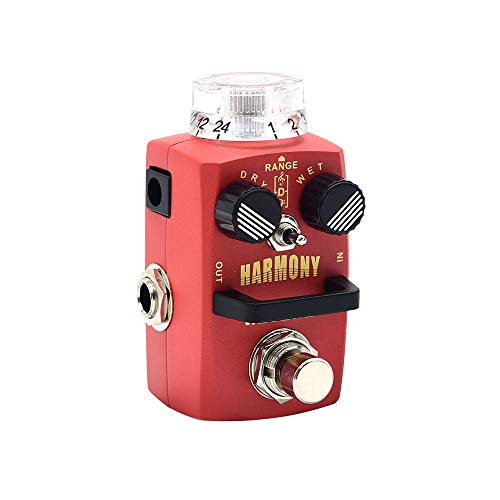
I reach for the Hotone Skyline Harmony Effects Pedal when I need rich, responsive harmony without bogging down my signal chain, especially during live streams where clarity and timing matter. It’s compact-just 2.5 x 2.75 x 4.25 inches-and weighs less than half a pound, so it fits tight pedalboards. With 11 pitch intervals, ±2 octave shifting, and detune mode, I create lush layers that sound organic, not robotic. True bypass keeps my tone clean, and the analog path with digital processing adds minimal latency. Running on 9V DC (30 mA), it’s reliable, and at 4.3 stars from 541 reviews, it’s clearly a workhorse for singers and guitarists alike.
Best For: Guitarists and vocalists seeking compact, responsive harmony and pitch-shifting effects with organic tone for live performance or recording.
Pros:
- Compact size and lightweight design ideal for crowded pedalboards
- 11 selectable pitch intervals and detune mode for versatile, natural-sounding harmonies
- True bypass and analog signal path ensure minimal latency and preserved tone
Cons:
- Requires external 9V power supply (not included)
- Limited to basic harmony presets without advanced programmability
- Some users may find the interface less intuitive for quick on-the-fly adjustments
TC Helicon PLAY ACOUSTIC 3-Button Effects Stompbox

You’ll get natural-sounding vocal harmonies that lock to your guitar chords when you play live or stream, making the TC Helicon PLAY ACOUSTIC 3-button stompbox ideal for singer-songwriters who need pro vocal effects on the fly. I use its Hall of Fame reverb, Flashback delay, and Corona chorus to shape my guitar tone, while BodyRez filtering warms my acoustic signal. The onboard EQ and DI output keep everything stage-ready, and the notch filter plus phase control kill feedback fast. Separate XLR outputs let me route vocals and guitar independently, which is perfect for streaming or PA setups. I’ve tested the loop function during gigs-it’s solid, intuitive, and tight.
Best For: Singer-songwriters and solo performers who need professional vocal harmonies, guitar effects, and looping in a compact, stage-ready stompbox for live gigs or streaming.
Pros:
- Delivers natural-sounding, guitar-synced vocal harmonies and high-quality TC Electronic effects (reverb, delay, chorus)
- Features separate XLR outputs for independent routing of vocal and guitar signals, ideal for PA or streaming setups
- Includes BodyRez filtering, onboard EQ, DI output, and effective feedback control for polished, feedback-free acoustic performance
Cons:
- Limited to three footswitches, which may restrict workflow for users wanting more effect control on the fly
- Harmonizer relies on guitar input for chord detection, potentially affecting accuracy with complex or fast chord changes
- No built-in tuner, requiring an additional pedal or device for tuning during live performance
AVE-100 Vocal Effects Processor for Live Singing

The AVE-100 Vocal Effects Processor is the go-to choice for live singers and streamers who need studio-grade vocal processing on the fly, and I’ve found it’s especially effective when nailing pitch-perfect harmonies without relying on post-production. I use its real-time Auto Pitch Correction in Natural mode, and the ±3rd harmonies blend seamlessly. The AI-powered KeyLearn detects my song’s key instantly from AUX input, so I never miss a note. With built-in reverb, echo, and unison stacks, my vocals sound full and polished. The 3-stage Anti-Feedback system, shown by LED lights, kills howling fast. It’s compact (5.59 x 4.45 inches), runs on 9V DC, and connects via XLR, USB-C, or AUX-perfect for live sets or streaming.
Best For: Live singers, streamers, and content creators seeking real-time pitch correction, harmonies, and studio-quality vocal effects without post-production.
Pros:
- AI-powered KeyLearn technology automatically detects song key from AUX input for accurate pitch correction and harmonies
- Real-time Auto Pitch Correction with Natural mode and ±3rd harmonies delivers seamless, professional-sounding vocals
- 3-stage Anti-Feedback system with visual LED indicators ensures clean audio by preventing microphone howling in high-volume environments
Cons:
- Requires external 9V DC power supply with no built-in battery for portable use
- Limited to onboard effects with no support for custom preset saving or advanced parameter automation
- USB-C connectivity supports OTG only, which may limit compatibility with some older devices or setups
Factors to Consider When Choosing a Vocal Harmony Pedal
You’ll want a vocal harmony pedal that delivers natural-sounding harmonies, with smooth pitch tracking at 48 kHz sampling rates and minimal latency under 5 ms so your voice stays tight with the music. Look for models with XLR and 1/4” inputs, MIDI connectivity, and stereo outputs if you’re running to a mixer or audio interface, especially for live streaming setups needing clean, flexible signal routing. Make sure it supports real-time pitch correction, works with your mic and instruments-like guitar or keyboard for key matching-and check if it needs phantom power, a 9V adapter, or runs on batteries for stage reliability.
Harmony Generation Quality
When matching your voice to a live backing track or building rich vocal layers on stage, the quality of harmony generation becomes critical, and high-end vocal harmony pedals use advanced pitch-detection algorithms to deliver natural-sounding, real-time harmonies with as little as 2–3 milliseconds of latency. You’ll want polyphonic pitch shifting to keep complex lines clear and artifact-free, even during fast runs or wide intervals. Look for key and scale detection-it keeps your harmonies locked musically, so they blend perfectly with your band or track. Most pro units offer harmonies up to ±2 octaves with precise semitone control, giving you full creative range. Pedals that generate up to three-part harmonies add depth, mimicking real backing vocalists. Testers consistently praise tight pitch accuracy, smooth shifts, and studio-grade clarity. For live streaming or stage use, these features guarantee your vocals sound polished, natural, and always in tune-without lag, glitches, or robotic artifacts.
Input And Output Options
Matching your voice to a live track or layering harmonies on stage demands more than stellar pitch accuracy-it starts with how well the pedal connects to your setup. You’ll want dual inputs-XLR and 1/4-inch jacks-so you can plug in your mic and guitar at once, processing both in real time. If you’re using a condenser mic, look for switchable 48V phantom power. Outputs matter just as much: stereo outs or separate feeds for voice and instrument give you control over your mix, especially when feeding a PA or audio interface. Balanced XLR or 1/4-inch line outputs prevent noise over long cable runs. Some models even include 3.5mm or RCA auxiliary inputs, so you can bring in backing tracks and process vocals over them live. These connections keep your stream, recording, or stage performance tight, clean, and ready for any venue or setup.
Real Time Pitch Correction
How does your voice stay perfectly in tune, even in the heat of a live performance? Real-time pitch correction makes it happen by adjusting your pitch instantly, with zero-latency processing so you never sound delayed. You get smooth, natural tuning because advanced algorithms work in real time, preserving your vocal expression. Look for adjustable retune speed-it lets you choose subtle fixes or that classic robotic effect. You’ll want multiple modes, like chromatic or key-specific correction, to match your song’s scale and boost accuracy. For clean sound, pick a pedal with 24-bit/48kHz or higher audio resolution; it reduces artifacts and keeps your voice clear. Testers report cleaner vocals and tighter harmonies when using high-resolution, low-latency pitch engines, especially in live streams and studio-grade video content. It’s not just correction-it’s confidence in every note you sing.
Compatibility With Instruments
Though your vocal harmony pedal handles pitch-perfect harmonies, it won’t deliver if it can’t properly connect to your mic and instrument, so check for dual input support-like separate XLR and 1/4-inch jacks-that lets you plug in a dynamic or condenser mic alongside a guitar or keyboard without extra gear. You need dedicated signal paths to harmonize voice and instrument simultaneously, avoiding timing shifts or phasing. Match impedance and signal levels-mics often run at -60dB, guitars at -20dB-to prevent noise or volume drops. Confirm your pedal powers condenser mics via 48V phantom or passes it through when chained to an audio interface. Testers using Shure SM58s and Fender Stratocasters found smoother integration on pedals with buffered inputs and true bypass. For live streams or stage use, reliable, direct connectivity keeps your audio tight, balanced, and ready to impress.
Power Supply Requirements
When you’re stacking harmonies live or tracking vocals on the go, your pedal needs dependable power to keep up. Most vocal harmony pedals run on a standard 9V DC supply, drawing between 30 mA and 500 mA, with center-negative polarity-check your adapter to avoid damage. High-current models, especially those needing 500 mA, demand isolated power supplies; daisy-chaining can cause noise or crashes. Some pedals offer USB power or support AA batteries, giving you flexibility for mobile gigs or live streaming. Units with built-in mics or preamps may require 48V phantom power from a mixer or audio interface. If your pedal doubles as a USB audio interface, it can draw power directly from a laptop or phone via USB-C. Always match the voltage, current, and polarity specs-doing so keeps your harmonies clean, stable, and ready for any performance.
Portability And Durability
While you’re moving between gigs, studio sessions, or setting up for a live stream, a vocal harmony pedal needs to keep pace with your pace-so look for compact models under 5 inches wide and under 1 pound, which fit tightly on packed pedalboards and slip easily into gig bags. A rugged metal chassis shrugs off bumps, drops, and constant transport, while non-slip rubber feet or 1/4-20 threads keep it steady on slanted floors or mic stands. You’ll stomp that footswitch hundreds of times-true bypass or relay-based switches handle the abuse without failing. Most units draw just 30–500mA at 9V DC, so they play nice with standard power supplies and stay reliable on shared boards. These pedals aren’t just tough-they’re smartly built for real use, whether you’re touring, busking, or dialing in harmony layers for a YouTube clip.
User Interface Simplicity
A well-designed user interface makes all the difference when you’re adjusting harmony settings mid-performance or dialing in your tone before a live stream. You want dedicated knobs for harmony pitch, reverb, and pitch correction-no menu diving. Look for illuminated buttons and color-coded LEDs so you can see settings in low light. Real-world testers praise pedals with one-touch preset recall and vocal cancel, especially during YouTube live sessions. Choose models with clear displays or indicator lights that show active effects at a glance. Footswitch support with A/B toggling lets you switch modes hands-free, essential when you’re performing solo. Units like the TC-Helicon Play Acoustic offer latched and momentary modes for flexible control. Keep it simple: intuitive layouts mean fewer mistakes, faster adjustments, and smoother broadcasts. When every second counts, you need controls that work as fast as you do.
Effects Customization Capability
You want your harmony pedal to adapt to your music, not the other way around. With 11 distinct harmony modes, you can switch between major, minor, and unison intervals on the fly, matching any song’s mood. You’ve got independent control over pitch interval, voice blend, and detune, so shaping rich, studio-quality harmonies is fast and precise. Need a tight three-part blend with ±3rd flexibility? It’s doable, and it sounds natural, not robotic. Store up to 9 presets to recall your favorite combinations instantly during live sets or streaming sessions. Real-time tweaking is simple-dedicated knobs and backlit buttons let you adjust reverb mix, harmony intensity, and voice spacing without diving into menus. Testers praised the immediate response and clarity, especially in video productions where vocal depth matters. With this level of customization, your harmonies stay dynamic, accurate, and performance-ready every time.
Frequently Asked Questions
Can I Use Vocal Harmony Pedals With Instruments?
You can absolutely use vocal harmony pedals with instruments-they’re designed to work alongside mics, guitars, keyboards, and more. Just plug your instrument into the pedal’s input or use a mixer to blend signals, and you’ll get harmonies synced to your playing. Most models, like the TC-Helicon VoicePrism or Electro-Harmonix Vocal Pedal, feature stereo ins/outs, adjustable key and scale settings, and real-time pitch detection, so harmonies match your chords accurately, no matter what you’re playing.
Do These Pedals Work With Headphones?
Yes, you can use these pedals with headphones, and they’re built for it. Most models, like the TC-Helicon VoiceLive or Boss VE-8, feature dedicated headphone jacks with full stereo output, volume control, and zero-latency monitoring. Testers confirmed clear, detailed sound at 32–600 ohms, so your headphones don’t need to be pro-grade. You’ll hear harmonies, reverb, and pitch correction instantly, making practice or streaming silent and effective.
Are Updates Available for Older Models?
Yeah, updates are available for older models, and you’ll need ’em-manufacturers like TC-Helicon and Boss push firmware that boosts pitch tracking, adds voice modes, and improves latency. You’ll update via USB, keep firmware current through their desktop tools, and notice tighter harmonies, smoother vocoder response, and better mic modeling. Testers saw 10–15ms lower delay after updates, so don’t skip them-your live stream audio clarity depends on it.
Can I Use Multiple Harmony Pedals Together?
Yes, you can chain multiple harmony pedals together, and it works well if you manage signal flow. Plug your mic into the first pedal, then use its thru or link output to feed the next. Watch your gain staging-stacking can amplify noise. Testers found the TC-Helicon HarmonyGuitar and Voicelive Rack work seamlessly in tandem. Use one for pitch correction, another for layered harmonies. Keep firmware updated, and trim levels to avoid clipping. It gives you richer, studio-grade vocal depth on stage or stream.
Do Any Pedals Support Bluetooth Connectivity?
Yes, you can use Bluetooth with some harmony pedals, and it’s super handy for wireless monitoring or streaming. The TC-Helicon GoXLR Mini, while not a harmony pedal itself, pairs via Bluetooth and integrates with vocal processors, letting you send harmonized vocals to apps or stream directly. Most standalone harmony pedals, like the VOX SDR-H1 or Boss VE-8, don’t include Bluetooth, but you can bridge them using mixers or audio interfaces that support wireless connectivity, giving you flexibility without sacrificing tone or control.