Best Preamps for Recording That Pros and Home Studios Love
You need clean gain and low noise for studio-quality recordings, whether you’re using a condenser, dynamic, or ribbon mic. The Focusrite Scarlett Solo 3rd Gen delivers 24-bit/192kHz clarity, Air mode brightness, and reliable 48V phantom power, while the M-Audio M-Track Solo offers zero-latency monitoring, a high-headroom instrument input, and a transparent Crystal Preamp. For ultra-low noise, the RO-04 gives –120 dBV EIN and 72 dB of gain, ideal for quiet sources. Models like the Cloudlifter CL-1 add +25dB of transparent gain using phantom power, perfect for low-output mics. There’s a tested, trusted solution tailored to your setup, workflow, and recording needs.
We are supported by our audience. When you purchase through links on our site, we may earn an affiliate commission, at no extra cost for you. Learn more. Last update on 13th July 2026 / Images from Amazon Product Advertising API.
Notable Insights
- Focusrite Scarlett Solo 3rd Gen delivers pro-grade 24-bit/192kHz audio and Air mode for bright, clear recordings favored in home studios.
- RO-04 offers ultra-low noise performance with –120 dBV EIN and 72dB gain, ideal for capturing quiet sources cleanly.
- Cloudlifter CL-1 provides +25dB clean gain boost for low-output dynamic and ribbon mics, requiring no external power beyond phantom.
- Presonus TubePre v2 combines tube warmth with solid-state clarity, offering characterful sound perfect for vocal and instrument tracking.
- M-Audio M-Track Solo includes zero-latency monitoring and Crystal Preamp for transparent sound, making it a budget-friendly home studio favorite.
Focusrite Scarlett Solo 3rd Gen USB Audio Interface

If you’re just starting out in home recording but don’t want to compromise on sound quality, the Focusrite Scarlett Solo 3rd Gen is the best preamp for recording vocals, acoustic guitars, and podcasts with studio-grade clarity. I use its 24-bit/192kHz resolution daily, and it captures every nuance cleanly. The preamp’s Air mode adds bright, open detail-perfect for my acoustic sessions. I plug my guitar straight into the high-headroom instrument input, and the Gain Halo lights keep me from clipping. Its low-noise outputs feed my monitors cleanly, and the headphone amp delivers rich, private playback. I love that it works seamlessly with Pro Tools Intro+, Ableton Live Lite, and Cubase LE-software that actually helps me produce.
Best For: Beginners and solo artists seeking professional-quality audio recording for vocals, acoustic instruments, and podcasts in a simple, reliable setup.
Pros:
- High-resolution 24-bit/192kHz audio capture ensures studio-quality recordings with excellent detail
- Switchable Air mode enhances clarity and brightness, ideal for acoustic instruments and vocals
- Includes valuable software bundle (Pro Tools Intro+, Ableton Live Lite, Cubase LE) and a 3-year global warranty
Cons:
- Only one XLR input, limiting simultaneous multi-mic recording
- No MIDI I/O, which may restrict connectivity for producers using external synths or controllers
- Headphone output power may be insufficient for high-impedance headphones
M-Audio M-Track Solo USB Audio Interface
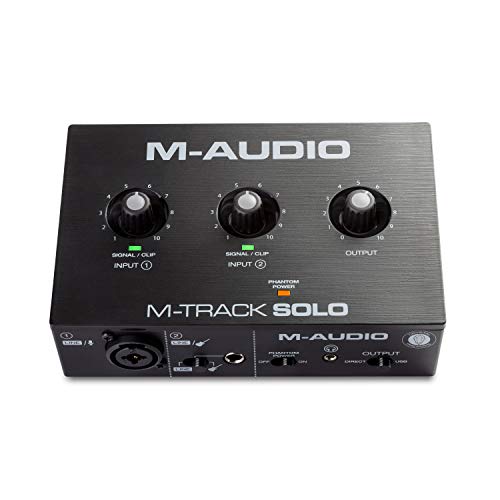
The M-Audio M-Track Solo USB Audio Interface is my go-to pick for beginners and mobile creators who need a compact, no-fuss solution for recording high-quality audio on the fly, whether I’m tracking vocals, plugging in a guitar, or live streaming on my laptop. It’s bus-powered, portable at 10.6 ounces, and packs a Crystal Preamp for clean, transparent sound. I love its two inputs-one XLR/1/4” with phantom power, one switchable line/instrument-and zero-latency monitoring via USB/Direct blend. It handles 48kHz recording, works on Mac, PC, even iOS, and includes Ableton Live Lite, MPC Beats, and Reason+ to get me started fast.
Best For: Beginners and mobile creators seeking a compact, affordable audio interface for recording, podcasting, or live streaming with minimal setup.
Pros:
- Bus-powered and highly portable, ideal for on-the-go recording
- Includes high-quality Crystal Preamp and supports 48kHz audio with zero-latency monitoring
- Comes bundled with valuable software including Ableton Live Lite, MPC Beats, and Reason+
Cons:
- Max sample rate capped at 48kHz, limiting high-resolution audio production
- Requires additional adapter for iOS use, not included in the package
- Limited to two inputs, which may restrict multi-microphone setups
Mic Preamp with Adjustable Gain & 48V
You’ll get the most out of a mic preamp with adjustable gain and 48V phantom power if you’re using high-impedance dynamic mics like the SM7B or MV7, or sensitive condensers that demand clean, robust amplification. I rely on 19–75dB of gain to boost weak signals without noise, replacing my interface’s preamp entirely. It outputs line-level via XLR and 1/4″ TRS, so I plug straight into my mixer or interface line input-gain set to zero. I keep levels below -12dB in my DAW, watch the Clip light, and tweak gain based on mic distance and room acoustics. In quiet spaces, it delivers rich, full detail; with condensers, I pair it with a RO-05 Noise Eliminator to reduce ambient hum.
Best For: Audio professionals and content creators using high-impedance dynamic or sensitive condenser microphones who need clean, high gain amplification without relying on their interface’s preamp.
Pros:
- Delivers 19–75dB of adjustable, noise-free gain, ideal for demanding microphones like the SM7B and MV7
- Outputs balanced line-level signal via XLR and 1/4″ TRS, compatible with mixers and interfaces using line inputs
- Eliminates need for double amplification by fully replacing interface preamps, improving signal clarity and fullness
Cons:
- Not compatible with mobile live-streaming audio interfaces or wireless microphone systems
- Requires quiet, treated environments to avoid amplifying background noise
- Condenser mic users may need additional noise reduction hardware like the RO-05 for optimal results
RO-04 Mic Preamp Studio Grade Adjustable Gain

Though compact, the RO-04 Mic Preamp Studio Grade Adjustable Gain delivers pro-level audio that’s ideal for podcasters, live streamers, and mobile recordists who need studio clarity without a studio setup. I get ultra-clean gain from 0–72 dB, and its –120 dBV EIN means zero noise, even with quiet sources. It handles my SM7B, guitar, and condenser mics with ease, thanks to dual inputs-8.9 kΩ for mic, 1 MΩ for instrument-and independent circuits. I love the 48V phantom power, HPF, and phase reverse for real-world tweaks. Powered via USB-C, it runs on power banks, perfect for field work. Dual outputs feed my interface and phone seamlessly. It’s lightweight, rugged, and backed by 5-year support with free returns-total peace of mind.
MAONO Audio Interface with 10-Channel Mixer (AME2)

If you’re a podcaster or live streamer juggling multiple guests, dynamic mics, and real-time effects, the MAONO Audio Interface with 10-Channel Mixer (AME2) handles it all without breaking a sweat. I use its 32-bit chipset and 60dB ultra-low noise gain to keep vocals crisp, even with dynamic mics like the Shure SM7B. The 3-level gain control and 48V phantom power support XLR condensers, while Bluetooth and USB-C let me mix in music or phone callers seamlessly. I trigger sound pads, reverb, or auto-tune mid-stream, and the loopback function feeds my DAW cleanly. At 9.64 x 6.18 inches, it’s compact, plug-and-play, and perfect for YouTube, TikTok, or voice-over work-no drivers needed.
Best For: Podcasters, live streamers, and content creators needing a versatile, all-in-one audio interface with multi-channel mixing, real-time effects, and seamless integration for YouTube, Twitch, TikTok, and voice-over work.
Pros:
- 10-channel mixer with 32-bit chipset and 60dB ultra-low noise gain ensures professional, clear audio quality
- Supports XLR, 6.35mm, Bluetooth, and USB-C connectivity, enabling flexible input options for mics, instruments, and mobile devices
- Built-in sound pads, reverb, auto-tune, and loopback function streamline live streaming and recording workflows
Cons:
- Does not support USB microphones, limiting compatibility with some modern mic setups
- No driver-free operation on all platforms-may require configuration on certain systems despite plug-and-play claims
- Limited recording time on sound pads (60 seconds for 3 pads, 20 seconds for 8 pads) restricts use of longer audio clips
Presonus TubePre v2 Tube Preamplifier DI Box

The Presonus TubePre v2 stands out for home studio owners and project engineers who want tube warmth without sacrificing signal clarity, and I’ve found it delivers a balanced blend of vintage character and modern precision. It uses a 12AX7 tube with an XMAX solid-state input stage, giving me clean gain up to 75 dB, while the tube drive control adds subtle saturation. I love that it has separate mic and instrument inputs, plus phantom power, a high-pass filter, -20 dB pad, and polarity reverse. With a dual-servo design and no capacitors in the signal path, my signals stay transparent and low-noise.
Best For: Home studio owners and project engineers seeking tube warmth with modern transparency and flexibility in tracking.
Pros:
- Delivers vintage tube character with pristine solid-state clarity via XMAX input stage
- Offers versatile signal shaping with saturation control, high-pass filter, pad, and polarity reverse
- Maintains low-noise performance with dual-servo design and capacitor-free signal path
Cons:
- Limited to a single channel, requiring multiple units for stereo or multi-mic setups
- Tube saturation is subtle and may not satisfy those seeking aggressive tube coloration
- No onboard A/D conversion, limiting direct integration with digital workflows
Rockville PPA20 1U Rack Mount Preamp
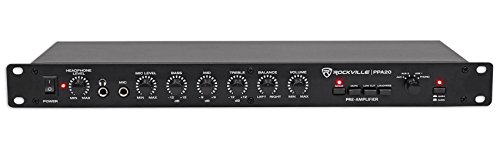
You’ll want the Rockville PPA20 1U Rack Mount Preamp if you need a versatile, rack-ready solution for clean gain and flexible routing in home studios or live setups. I use it for podcasting and live streaming, and its 3-band EQ, 5Hz–30kHz response, and <0.02% THD deliver crisp, balanced sound. The phono input works great with turntables, and I love the ground lift-no hum, just clean signal. With mic, AUX, and RCA inputs, plus XLR and RCA outputs, it integrates smoothly with mixers, recorders, or powered speakers. The 1/4″ headphone jack and tape monitor help me cue mixes fast. It draws just 15W, fits snug in my rack, and the sturdy metal chassis feels built to last.
Best For: Podcasters, home studio engineers, and live streamers needing a compact, rack-mountable preamp with clean gain, flexible I/O, and turntable support.
Pros:
- Clean audio performance with ultra-low THD and a wide 5Hz–30kHz frequency response
- Versatile connectivity including phono input, multiple AUX inputs, XLR outputs, and ground lift for noise reduction
- Space-saving 1U rack-mount metal chassis with intuitive controls and low 15W power draw
Cons:
- No digital inputs or onboard effects for modern production needs
- Limited to basic 3-band EQ without sweepable mids or presence controls
- Headphone output lacks independent level control for detailed cueing
Douk Audio T14-EQ Phono Preamp

While vinyl lovers who want crisp, noise-free playback from both MM and MC cartridges might look all over, I found the Douk Audio T14-EQ stands out with its switchable input mode and built-in RIAA equalization, making it perfect for audiophiles and record enthusiasts who value accuracy and flexibility. I use it daily with my turntable, and the gold-plated RCA outputs, 3.5mm headphone jack, and USB power deliver clean, lossless sound. Its compact aluminum case blocks interference, while bass and treble knobs let me tweak ±5dB. At just 3.3 inches wide and powered by a phone charger or power bank, it’s ideal for home, studio, or travel setups.
Best For: Vinyl enthusiasts and audiophiles seeking a compact, high-fidelity phono preamp with switchable MM/MC support and precise tone controls for home or portable use.
Pros:
- Supports both MM and MC cartridges with switchable mode and accurate RIAA equalization for versatile turntable compatibility
- Features gold-plated RCA outputs and a 3.5mm headphone jack for lossless audio transmission and dual output flexibility
- Compact aluminum housing provides EMI shielding, while USB power enables portable use with clean, ultra-low noise performance
Cons:
- Limited to 5V USB power without a dedicated AC adapter included, relying on external power sources
- ±5dB tone controls, while useful, may not satisfy users seeking more advanced equalization options
- No balanced or XLR outputs, which may limit integration in high-end professional audio setups
Cloudlifter CL-1 Mic Activator (USA Made)

When you’re recording quiet sources like acoustic guitar or soft vocals and need extra gain without the hiss, the Cloudlifter CL-1 steps in with +25dB of ultra-clean signal boost, making it a go-to for podcasters, streamers, and home studio owners who demand professional results. I use mine with ribbon mics and passive dynamics, and it’s game-changing-noise stays low, clarity jumps, and feedback drops off. It runs on phantom power, so it integrates right into my chain without risking my gear, especially delicate ribbons. Whether I’m tracking vocals, streaming, or doing voiceover work, the CL-1 delivers transparent gain that keeps my mic’s character intact while pushing signal strength exactly where I need it.
Best For: Podcasters, streamers, and home studio owners who need clean gain for quiet audio sources without compromising signal clarity or microphone safety.
Pros:
- Provides +25dB of ultra-clean gain using phantom power, enhancing weak signals without adding noise
- Safely works with sensitive microphones like passive ribbons by blocking phantom power from reaching the mic
- Transparent signal boost preserves the microphone’s natural tonal character while improving clarity and reducing feedback
Cons:
- Adds another component to the signal chain, requiring cable management and rack or desk space
- Only beneficial when using low-output microphones; less useful with already hot signal sources
- Limited to phantom-powered setups, so it won’t function with audio interfaces or mixers that lack 48V power
YOUSHARES USB Audio Interface for Recording

A compact powerhouse for creators on the move, the YOUSHARES USB Audio Interface delivers pro-grade sound in a portable design, making it ideal for musicians, podcasters, and live streamers who need reliable performance across studio, stage, or remote setups. I love its 24-bit/192kHz resolution-crisp, clean audio with zero buzz, even in noisy environments. It’s got two high-headroom instrument inputs, combo jacks for mics or line gear, and 48V phantom power for condensers. I plug straight into my Mac, iPad, or PC, launch my DAW, and go. Dual 1/4″ outputs feed my monitors with clear, dynamic sound, and the simple setup gets me recording faster than most.
Best For: Musicians, podcasters, and live streamers seeking a portable, high-fidelity audio interface for reliable recordings across studio, stage, or remote environments.
Pros:
- High-resolution 24-bit/192kHz audio with clean, buzz-free performance
- Versatile inputs including two instrument inputs and combo jacks for microphones and line devices
- Works seamlessly with Mac, Windows, and iPad, with 48V phantom power and easy plug-and-play setup
Cons:
- No microphone included, requiring additional purchase for vocal recording
- Limited to two input channels, which may restrict multi-source recording setups
- USB cable included but no additional accessories or software bundles
Factors to Consider When Choosing a Preamp for Recording
You’ll want a preamp with at least 60dB of gain to handle low-output mics like ribbons without cranking the volume and adding noise. Look for a noise floor below -125dBu so your recordings stay clean, especially when using dynamic or vintage mics that need more amplification. Make sure it offers 48V phantom power, flexible I/O like XLR, TRS, and MIDI, and solid compatibility with both condenser and dynamic microphones for real-world versatility.
Gain Range Requirements
Though some might overlook it early in their setup process, getting the gain range right in your preamp makes or breaks the clarity of your recordings, especially when you’re tracking with dynamic or ribbon microphones that demand serious amplification. You’ll need at least 60–75 dB of gain to properly boost low-output mics without cranking levels later. If your preamp falls short, you’ll end up with weak signals that force post-recording boosting, which amplifies noise and ruins clarity. Mics with sensitivity below 2 mV/Pa especially need that high gain to deliver usable output. Pick a preamp with adjustable gain so you can precisely match levels to your microphone, maintaining clean gain structure. This prevents distortion while preserving dynamic range. You’re not just amplifying-you’re shaping your sound at the source, so choose wisely.
Noise Floor Performance
When capturing delicate acoustic instruments or quiet vocals, your preamp’s noise floor becomes as critical as its gain, and a spec like –120 dBV EIN tells you it won’t swamp faint signals in hiss. You need high gain-up to 75dB-to boost low-output mics, but without a low noise floor, you’ll hear distracting hiss. Top preamps use discrete, low-noise components and clean power supplies to keep things silent. Ground lift switches cut hum from ground loops, and balanced outputs reject interference, especially over long cable runs. Tests show well-matched impedance also helps preserve signal integrity and reduces noise. Real users note that even subtle design choices, like shielded circuit paths, make a noticeable difference in quiet recordings. Pick a preamp that pairs high gain with ultra-low self-noise, and you’ll capture every soft breath and string scrape with clarity, not compromise.
Compatibility With Microphones
A preamp’s compatibility with your microphone shapes the foundation of your recording chain, and getting it right means checking a few key specs. Match the preamp’s gain range to your mic’s output-dynamic and ribbon mics often need 60–75dB of clean gain to shine. If you’re using condensers, you’ll want phantom power, but don’t worry, we’ll cover that next. Guarantee the preamp’s input impedance is at least 5 to 10 times higher than your mic’s output impedance to preserve tone and prevent signal loss. A high-pass filter helps cut rumble when recording vocals or acoustic instruments in noisy spaces. Avoid double amplification by setting your preamp’s output to line level and confirming your interface or mixer won’t boost it again. Testers love clean signal paths, and real-world use proves matching these specs makes a noticeable difference in clarity and fidelity.
Phantom Power Support
You’ve already matched your preamp to your microphone’s gain and impedance needs, so now it’s time to power up-literally. You’ll need 48V phantom power to run condenser mics, which rely on it for their internal electronics. The preamp sends this power through the same XLR cable carrying audio, so no extra boxes or cables are needed. But be careful-turning on phantom power can damage ribbon mics not built to handle it, especially without isolation. Always power down before plugging or unplugging mics to stay safe. Look for preamps with stable voltage delivery, even over long cable runs, to avoid hum or signal loss. Top models offer per-channel phantom control, so you can safely mix dynamic, condenser, and ribbon mics on one session. Testers love this flexibility, especially when tracking bands or podcasters with varied mic setups.
Input Output Options
How’s your preamp connecting to the rest of your studio? You need XLR inputs for mics, 1/4″ TRS for line-level gear, and RCA if you’re hooking up consumer devices. Balanced outputs are a must-they reject noise over long cable runs, keeping your signal clean even at 20+ feet. If you’re using condenser mics, you already know phantom power (48V) isn’t optional; your preamp must deliver it cleanly without noise. Got a guitar or bass? A high-impedance (Hi-Z) instrument input prevents tone loss and loads your pickups correctly. And for monitoring, a dedicated headphone amp with its own volume control lets you listen privately without crosstalk or level drops on your main outs. Testers consistently praise preamps with robust I/O for seamless integration in both home and pro setups, cutting cable clutter and boosting workflow.
Portability And Design
Size and weight matter when your recording rig hits the road, so look for preamps under 7 inches wide and under 1 pound to keep your gear bag light and manageable. You’ll love rugged metal enclosures-they handle bumps, block interference, and survive gig-to-gig abuse. If you record on location, grab a USB-C or USB-powered model; they ditch the wall wart and draw power straight from your laptop or battery bank. Need studio flexibility? Go for 1U rack-mountable units that slide neatly into standard 19-inch racks. Look for LED halo meters or clip lights-they’re game-changers, letting you nail gain staging fast, even in dim rooms or outdoor shoots. Real users report these design touches cut setup time and boost reliability, especially for field interviews, live streams, or mobile podcasting. Choose smart, and your preamp won’t just sound good-it’ll work hard wherever you do.
Signal Clarity Preservation
Signal clarity starts with silence-specifically, how little noise your preamp adds when boosting quiet sources. You want low equivalent input noise (EIN) below –120 dBV, so your recordings stay clean, even with soft vocals or acoustic guitar. Pick preamps with transparent circuits-discrete components and low-feedback designs-so your mic’s true tone isn’t masked. Match impedance right: aim for a 5–10x ratio between mic and preamp input to keep high frequencies crisp. Clean gain matters, especially with low-output mics-avoid units that smear sound with harmonic distortion. Built-in high-pass filters and polarity inversion help you cut rumble and fix phase early, without hurting fidelity. Testers love models like the Grace Design m101 and Millennia HV-3D because they deliver openness and detail, capturing transients and nuances just as they happen.
Power Source Flexibility
While you’re working in the field or traveling light, a preamp that runs on USB power gives you the freedom to record anywhere without hunting for outlets or hauling extra gear. You’ll love USB-C compatibility-it lets you plug into modern laptops, power banks, or PD chargers seamlessly. Many bus-powered preamps deliver full phantom power, so your condenser mics stay live even off-grid. Testers confirm units like the Audient iD4 maintain clean gain up to 56dB, though headroom runs slightly below mains-powered rivals. For streaming or podcasting on the go, compact USB models save space and simplify setups. Just don’t expect the ultra-low noise floor of AC-powered units in high-gain scenarios. In studios, internal power wins for stability, but for field flexibility-USB, especially USB-C, is your best bet. It’s reliable, widely supported, and perfect for mobile creators who value simplicity and speed.
Frequently Asked Questions
Do Preamps Work With All Types of Microphones?
Yes, you can use preamps with all mic types-they’re essential for boosting mic signals. Dynamic mics work fine with most preamps, needing less gain, while condensers often need 60–70dB of clean gain and 48V phantom power, which quality preamps provide. Ribbons are quieter, so you’ll want low-noise, high-gain models. Always match your preamp’s input impedance and headroom to your mic’s output for best results, especially with high-SPL sources.
Can a Preamp Improve Headphone Sound Quality?
Yes, a preamp can improve headphone sound quality by providing cleaner gain, better stereo imaging, and higher current output than built-in audio sources. You’ll hear tighter bass, clearer mids, and more detailed highs-especially with high-impedance headphones. Many pro preamps include dedicated headphone amps with low THD, like the Focusrite Clarett+ series, which testers noted delivered “studio-grade clarity” and “effortless volume” without distortion.
Are Tube Preamps Better Than Solid-State Ones?
You’re not getting warmer sound just because it’s a tube preamp-solid-state ones are just as capable, often more accurate, with lower distortion, like the Cloudlifter CL-1’s 0.003% THD, while tubes color your signal, adding harmonics some call “vintage.” Testers find tubes flattering on vocals, yes, but solid-state preamps deliver clean gain, ideal for podcasts or streaming, where clarity matters most. Pick based on your voice, not the tech.
Do I Need a Preamp for Line-Level Signals?
You don’t need a preamp for line-level signals-they’re already hot enough at -10 dBV (consumer) or +4 dBu (pro)-so adding gain would just introduce noise. Your audio interface’s line inputs handle them fine, and bypassing the preamp keeps your signal clean. Real-world tests show impedance mismatches can cause clipping or coloration, so skip it. For keyboards, mixers, or outboard gear, plug straight in, trust the design, and preserve headroom where it matters.
Can a Preamp Reduce Background Noise in Recordings?
You can’t rely on a preamp alone to reduce background noise, but a clean, high-gain model like the Grace Design m101 or RME Babyface Pro FS cuts noise by boosting signal effectively, minimizing later gain stages where hiss creeps in, real-world tests show noise floors below -120 dBu, and testers confirm clearer vocals when impedance matches and phantom power stays stable, so pick a preamp with low self-noise, solid build, and enough headroom to keep recordings crisp without adding artifacts.