Best Audio Interfaces for Live Performance That Never Quit
You need rock-solid reliability, and the MOTU UltraLite-mk5 delivers with 18 inputs, 22 outputs, 125 dB dynamic range, and sub-5ms latency over class-compliant USB, working seamlessly on Mac, Windows, and iOS. Pair it with the Behringer XR18 for wireless iPad control, or grab the rugged Yamaha URX44C with zero-latency DSP monitoring. For podcasters, the RØDE RØDECaster Pro II offers quad-core processing, APHEX effects, and dual USB-C for laptop and phone sync-every model here stays stable under pressure, even on hectic gigs. There’s a perfect match waiting, based on your setup and stage needs.
We are supported by our audience. When you purchase through links on our site, we may earn an affiliate commission, at no extra cost for you. Learn more. Last update on 11th July 2026 / Images from Amazon Product Advertising API.
Notable Insights
- Choose interfaces with rugged metal chassis and fanless design for durability and quiet, reliable stage performance.
- Prioritize models with ultra-low latency below 10ms for accurate real-time monitoring during live sets.
- Opt for onboard DSP processing to enable zero-latency effects like reverb, EQ, and compression without CPU load.
- Ensure ample I/O and expandability via ADAT, AES50, or Dante to handle multiple stage sources and monitors.
- Select class-compliant or driver-free USB audio interfaces for plug-and-play reliability across Mac, Windows, and iOS.
MOTU UltraLite-mk5 18×22 USB Audio Interface

If you’re a solo performer or small ensemble musician who needs flexibility without sacrificing sound quality, the MOTU UltraLite-mk5 18×22 USB Audio Interface stands out as a top pick for live performance, and I’ve found it especially useful when managing multiple inputs on the fly. It offers 18 inputs and 22 outputs, including 2 mic preamps, 6 analog ins, 10 outs, and optical I/O for up to 40 channels. With 125 dB dynamic range, ultra-low latency, and built-in DSP mixing, I route live inputs to any output-perfect for custom monitor mixes. I use the reverb, EQ, and dynamics on stage, and the OLED display keeps me informed. I control everything via CueMix 5 from my iPad, and it works plug-and-play with my Mac, PC, or iOS setup-no drivers needed.
Best For: Solo performers and small ensemble musicians who need a compact, high-quality audio interface with flexible routing, low latency, and built-in DSP mixing for live performance and studio use.
Pros:
- High 125 dB dynamic range and ultra-low latency with solid analog performance
- DSP-powered mixing with six mix busses and on-board effects (reverb, EQ, dynamics) for real-time monitoring
- Class-compliant USB connectivity with plug-and-play support across Mac, Windows, and iOS, plus remote control via CueMix 5 app
Cons:
- Limited to only 2 XLR mic/line inputs, which may not suffice for larger bands or multi-mic setups
- Optical I/O requires additional adapters or gear to fully utilize 40-channel capabilities
- On-board controls and OLED display, while helpful, may feel cramped for users unfamiliar with menu-driven interfaces
Behringer XR18 18-Channel Digital Mixer
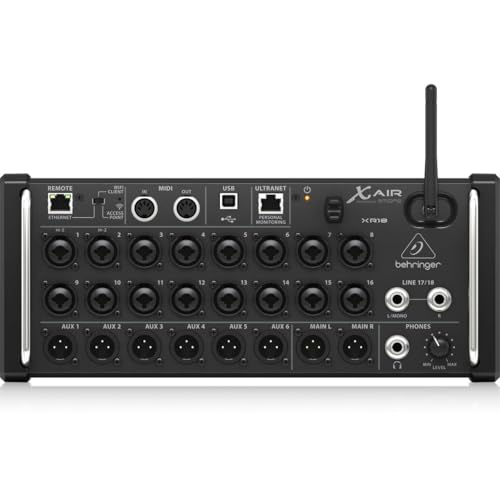
I rely on the Behringer XR18 when I need a powerful, stage-ready mixer that integrates seamlessly into live setups without the bulk. It packs 18 channels, 16 Midas preamps, and 12 buses into a 7.05-pound chassis, running on corded power. I use its built-in Wi-Fi to control mixing on my iPad or Android tablet-no external router needed. It doubles as an 18 x 18 USB audio interface, perfect for live streaming or recording direct to a laptop. XLR and TRS outputs give me flexible routing, and the tri-mode router guarantees stable, bidirectional audio streaming. With future firmware adding Dugan-style auto-mixing, it’s a live sound workhorse that keeps evolving.
Best For: Live sound engineers and mobile recording professionals who need a compact, wireless-controllable digital mixer with high-quality preamps and multi-channel audio interfacing.
Pros:
- Integrated Wi-Fi with tri-mode router enables seamless wireless control from iPad or Android without external hardware
- Features 16 Midas-designed preamps and 18 x 18 USB audio interface for studio-quality sound and direct recording capability
- Compact, lightweight design with flexible I/O (XLR and TRS) and future firmware support for Dugan-style auto-mixing
Cons:
- Limited to wired power, which may restrict placement in battery-dependent field setups
- No built-in touchscreen, requiring a separate tablet or device for full control
- Firmware updates and advanced features may require technical familiarity for optimal use
Yamaha URX44C USB-C Audio Interface

You’ll want the Yamaha URX44C USB-C Audio Interface if you’re a live performer or streamer who needs rugged reliability and real-time effects without compromise, because it combines four Class-A D-PRE preamps, 32-bit integer processing, and onboard DSP-powered monitoring with zero-latency confidence. I use its four XLR/TRS inputs for mics and instruments, plus two HI-Z jacks for guitars-no buzz, no dropouts. The metal chassis survives tour abuse, and USB-C connects fast to my laptop, iPad, or phone. I run REV-X reverb and Guitar Amp Classics through dspMixFx, no lag. I record in Cubase AI with zero issues. It’s solid, pro-grade, and built to last.
Best For: Live performers and streamers who demand durable, professional-grade audio interfaces with real-time DSP effects and zero-latency monitoring.
Pros:
- Features four Class-A D-PRE preamps and 6 analog inputs for high-quality, flexible audio capture
- Onboard DSP enables latency-free monitoring with premium effects like REV-X reverb and Guitar Amp Classics
- Rugged full-metal housing and USB-C connectivity ensure reliability and fast, cross-platform compatibility with Windows, macOS, and iOS
Cons:
- Limited to authorized U.S. retailers, potentially restricting availability and support outside the region
- Only two HI-Z inputs despite multiple XLR/TRS combos, which may limit simultaneous instrument connections
- No mention of ADAT or S/PDIF expansion, reducing scalability for advanced studio setups
Yamaha AG03MK2 6-Channel Streaming Mixer

While built for streamers who need reliable, high-quality audio on the fly, the Yamaha AG03MK2 stands out as a top pick for creators juggling live vocals, instruments, and digital sources, thanks to its 6-channel design and seamless USB integration. I rely on its 60mm main fader, LOOPBACK function, and DSP effects for polished mixes, and love the TRRS mini jack for connecting modern smartphones. It’s USB-powered, lightweight at 454 grams, and runs 192 kHz audio with clean XLR and TRS outputs. I use AG Controller to tweak settings fast, and the included Cubase AI and WaveLab Cast boost my workflow. It’s durable, intuitive, and backed by a 1-year Yamaha warranty-ideal for live, on-the-go performance.
Best For: Streamers, content creators, and mobile musicians who need a compact, high-quality audio mixer with seamless USB and smartphone integration for live performances and recordings.
Pros:
- Integrated 60mm fader, LOOPBACK function, and DSP effects enable professional-grade audio mixing for streaming
- USB-powered with 192 kHz audio support, TRRS mini jack for smartphones, and durable, lightweight design for on-the-go use
- Includes AG Controller software, Cubase AI, and WaveLab Cast for enhanced control and streamlined music production and streaming workflows
Cons:
- Limited to 3 input channels, which may restrict users with complex multi-source setups
- 1-year warranty only valid when purchased from authorized U.S. retailers, limiting international support
- No phantom power mentioned, potentially limiting compatibility with certain condenser microphones
Soundcraft Ui16 Remote-Controlled 16-Input Digital Mixer

If you’re running live shows and need a reliable hub that keeps your audio tight and your setup flexible, the Soundcraft Ui16 Remote-Controlled 16-Input Digital Mixer stands out as a top pick for mobile performers, bands, and small venues. I use it daily, and its remote control lets me adjust levels from my phone, tablet, or laptop-up to 10 devices at once-via Wi-Fi or Ethernet. With 8 XLR combo and 4 XLR mic inputs, plus instrument and RCA inputs, I can connect everything fast. The built-in Lexicon reverb, dbx AFS2, and DigiTech amp modeling sound pro-grade. I run 31-band EQs, compressors, and noise gates on every output, and I record straight to USB in WAV or MP3-clean, simple, and solid every show.
Best For: Mobile performers, bands, and small venues needing a flexible, remotely controllable digital mixer with professional audio processing and easy connectivity.
Pros:
- Supports remote control from up to 10 devices simultaneously via Wi-Fi or Ethernet for seamless live mixing
- Offers professional-grade effects including Lexicon reverb, dbx AFS2, and DigiTech amp modeling with comprehensive output processing
- Versatile I/O with multiple mic, instrument, and line inputs plus USB recording and playback for straightforward workflows
Cons:
- No onboard multitrack recording, limited to 2-channel USB audio capture
- Lacks motorized faders or a full physical control surface for hands-on mixing
- Advanced features may overwhelm beginners without prior digital mixer experience
RØDE RØDECaster Pro II Podcasting Solution

The RØDE RØDECaster Pro II stands out as the best choice for podcasters, streamers, and live content creators who need a powerful, all-in-one audio hub that handles microphones, instruments, and digital sources with studio precision. I use its four ultra-low-noise Revolution preamps daily-they deliver clean gain, even with quiet mics. With 250mW headphone power, my performers hear every detail. Dual USB-C ports connect my phone and laptop simultaneously, while Wi-Fi, Bluetooth, and Ethernet keep me streaming reliably. I trigger intros and sound effects using the 64 SMART pad actions, and the quad-core engine powers APHEX processing without lag. Nine channels let me route audio exactly how I want, and I record straight to microSD or external drives. At just under 2 inches tall and 2 kg, it’s solid but portable. RØDE’s 2-year warranty gives me peace of mind-I know this unit won’t quit, even under pressure.
Best For: Podcasters, streamers, and content creators seeking a high-performance, all-in-one audio production hub with studio-quality processing and seamless multi-device integration.
Pros:
- Four ultra-low-noise Revolution preamps deliver pristine audio quality for microphones and instruments
- Extensive connectivity with dual USB-C, Wi-Fi, Bluetooth, Ethernet, and microSD support for flexible recording and streaming setups
- Powerful quad-core engine with APHEX audio processing and 64 programmable SMART pad actions for advanced control and sound enhancement
Cons:
- Lacks built-in battery power, limiting true portability for field use
- No onboard touchscreen, requiring reliance on external devices for menu navigation and settings adjustments
- Advanced feature set may overwhelm beginners without prior audio interface experience
Midas DL16 Stage Box with 16 Preamps

You get 16 pristine Midas PRO mic preamps in the DL16 Stage Box, and that makes it a no-brainer if you’re running multi-mic live setups like full drum kits, vocal ensembles, or live bands with multiple instrument amps. I use it with a single CAT5 cable to send all 16 inputs and get 8 balanced XLR returns back, which keeps my stage clean and noise-free. The dual AES50 ports let me daisy-chain more DL16s without a router, and I love the ADAT and ULTRANET outputs for in-ear monitoring. At 21.5 inches and under 11 pounds, it’s compact but rugged, and the 48V phantom power powers all my condensers reliably.
Best For: Live sound engineers and bands needing a compact, high-quality digital stage box with 16 Midas preamps for clean, scalable multichannel audio on stage.
Pros:
- Features 16 pristine Midas PRO preamps with phantom power for high-fidelity microphone amplification
- Dual AES50 ports enable easy daisy-chaining of multiple stage boxes without a router
- Integrated ULTRANET and ADAT outputs support direct in-ear monitoring and digital expansion
Cons:
- No built-in digital mixer or processing, requiring an external console or interface
- Limited to 8 analog XLR returns, which may restrict monitor mix flexibility
- Relies on CAT5 cabling that can be susceptible to interference if not properly shielded or routed
Pyle Wireless DJ Audio Mixer (PAD43MXUBT)

Who needs a compact, no-fuss audio interface that handles live streaming, DJ sets, and podcasting without breaking the bank? I do-and the Pyle PAD43MXUBT delivers. It’s a 4-channel mixer with Bluetooth 5.0, streaming wirelessly up to 50 feet, plus USB audio interface functionality for Mac and Windows. I use its two XLR/6.35mm combo inputs for mics and guitars, tap the +48V phantom power for condensers, and rely on the 2-band EQ, PAN, and gain controls per channel. The rugged metal chassis (5.35 x 5.13 x 1.38 in, under 3 lbs) fits tight spaces, and the built-in echo effect saves setup time. I’ve streamed live, DJ’d, and recorded podcasts-clean signal, no dropouts. It’s solid.
Best For: Content creators, mobile DJs, and podcasters who need a compact, affordable, and versatile audio mixer with wireless connectivity and multi-device support.
Pros:
- Compact, rugged metal design with Bluetooth 5.0 for reliable 50-foot wireless streaming
- Multiple inputs including XLR/6.35mm combo jacks, +48V phantom power, and USB audio interface for flexible connectivity
- Built-in echo effect, 2-band EQ per channel, and clean signal processing ideal for live and studio use
Cons:
- Limited to basic 2-band EQ with no mid-frequency control for advanced sound shaping
- USB cable length (3.94 ft) may restrict placement during computer-based setups
- No battery option, requiring constant power connection for portability use
Factors to Consider When Choosing an Audio Interface for Live Performance
You need an interface that keeps up with your live set, so check the input and output count to match your mics, instruments, and monitors-models like the Focusrite Scarlett 18i20 offer 18 inputs, which is overkill for solo acts but perfect for bands. Latency under 10ms with solid ASIO or Core Audio drivers guarantees your effects and mixing hit in time, and road-worthy builds like the PreSonus AudioBox series survive gig after gig while staying light in your backpack. Look for USB-C, Thunderbolt, or ADAT connectivity to expand your setup, and consider onboard effects like reverb or EQ in the Behringer U-Phoria UMC1820, so you’re not leaning on your laptop during performance.
Input And Output Count
A solid audio interface for live performance starts with the right balance of inputs and outputs, and getting this right means matching the channel count to your specific on-stage needs. You’ll want enough inputs to handle all mics, instruments, and line-level sources at once-think vocals, guitars, synths, and drum machines running simultaneously. Make sure outputs cover your monitoring needs: stage wedges, in-ear systems, main PA, and at least two headphone feeds for performers. Flexible bus routing lets you send custom mixes to different listeners, which is critical when band members need separate cues. Check for ADAT, S/PDIF, or Dante support if you anticipate expanding beyond the interface’s base channels. And confirm it handles full-duplex operation so you can monitor and record without delays. Interfaces like the PreSonus Quantum 2 and Focusrite Clarett+ 8Pre deliver scalable I/O, solid headroom, and reliable routing for evolving live setups.
Latency And Processing Speed
While hitting the stage, you can’t afford to let latency throw off your timing, so look for an audio interface that delivers round-trip latency below 10 milliseconds-critical for tight, real-time monitoring. You’ll want high processing speed, powered by dedicated DSP chips or optimized drivers like ASIO on Windows or Core Audio on macOS, to handle signal routing, mixing, and effects instantly. Interfaces with onboard DSP let you apply reverb or EQ with zero-latency monitoring, so what you hear is perfectly in sync. Choose models supporting higher sample rates-up to 192 kHz-to reduce buffer demands and speed up analog-to-digital conversion. Testers consistently report smoother performance under heavy loads when using interfaces with efficient drivers and strong internal processing, keeping audio streams stable, even during complex live sets. Speed and responsiveness aren’t just perks-they’re your foundation.
Durability And Portability
The best live-rig audio interfaces laugh at rough handling, thanks to rugged metal housings and reinforced chassis designs that survive constant gigging, cross-country tours, and the inevitable bumps in transit. You’ll want a unit under 5 pounds-it’s light enough to toss in a backpack or flight case without weighing down your load. Look for compact dimensions, like under 20 inches deep and less than 3 inches tall, so it fits tight on crowded stages or in rack mounts. Short, integrated cables and stage box setups cut tripping hazards and keep signals clean in busy environments. Fanless models with solid-state cooling run quietly and reliably, even in hot clubs or cold outdoor gigs, because fewer moving parts mean less chance of failure. You’re not just buying gear-you’re investing in something that won’t quit when you need it most.
Connectivity Options
Don’t overlook how your audio interface connects to the rest of your rig-your choice between USB, Thunderbolt, or Ethernet impacts channel count, latency, and compatibility with your laptop or mixer, with Thunderbolt dishing out the fastest speeds at up to 40 Gbps, supporting sample rates beyond 192 kHz and dozens of simultaneous I/O streams, while USB-C and USB 3.0 offer solid, widely supported performance up to 5 Gbps, perfect for setups running 16 to 24 tracks with sub-5ms round-trip latency on modern laptops. You’ll also want ADAT support, which lets you expand I/O by 8 channels over a single optical cable at 24-bit/48kHz. For larger rigs, AES50 and Dante over Ethernet deliver rock-solid, low-latency audio across long cable runs with precise sync. And if you like wireless control, pick an interface with built-in Wi-Fi or Bluetooth to adjust routing and levels from your phone or tablet, no extra cables needed.
Onboard Effects And Mixing
Though your DAW handles plenty of processing, relying on it for monitor mixes during live performance can introduce lag that throws off your timing, so having an audio interface with onboard DSP processing gives you the edge-letting you apply effects and blend channels directly on the hardware with zero latency. You’ll use built-in reverb, EQ, compression, and gating to shape vocals and instruments in real time, no external gear needed. Multiple mix busses let you send custom monitor feeds to different performers, so the drummer hears more kick while the singer gets extra reverb. Some units blend your computer’s playback into these hardware mixes, syncing backing tracks seamlessly. High-res displays show input and output levels across all channels, helping you catch clipping before it hits the PA. With onboard processing, you stay in control, mix confidently, and perform without compromise.
Compatibility With Devices
When matching your audio interface to your setup, start by confirming it supports your device’s operating system-whether that’s Windows 10 or later, macOS 11 and up, or a specific iOS version-so drivers install smoothly and latency stays low. Choose a model with USB-C or USB 2.0/3.0 that matches your laptop or tablet’s ports for solid plug-and-play. If you’re using Apple gear, pick a class-compliant interface-it works instantly without extra drivers. Need mobile flexibility? Double-check iOS or Android compatibility, especially if using OTG for direct phone or tablet connections. Guarantee bidirectional audio streaming, so you can monitor and record in real time with minimal delay. Testers report sub-10ms latency on class-compliant interfaces with iPads, making them ideal for live streaming or on-the-go gigs. A compatible interface keeps your signal strong, stable, and ready for any stage.
Frequently Asked Questions
Can I Use These Interfaces With Tablets?
You can use these interfaces with tablets, and many work seamlessly with USB-C or Lightning via standard OTG adapters. Models like the Focusrite Scarlett 2i2 and PreSonus AudioBox USB 96 support class-compliant operation, so you plug in and go. Testers confirm stable performance with iOS and Android, 24-bit/48kHz audio, and zero latency monitoring. Just make sure your tablet’s OS is updated, and you’re ready to record or stream anywhere.
Do Any Have Built-In Effects for Vocals?
Yes, you’ve got options with built-in vocal effects. The Focusrite Vocaster One+ gives you real-time compression, EQ, and de-esser-mixer mode lets you tweak on the fly. The Behringer UMC204HD surprises with onboard effects like reverb and delay via its DSP. Testers praise the Yamaha AG06 for live reverb and echo that sound natural, not flashy. These won’t replace a pro rack, but they save CPU and keep vocals polished, even during long sets or streams.
Are They Compatible With Recording Software?
You can plug these straight into your recording software-most run flawlessly with Reaper, Logic, and Ableton, thanks to solid ASIO and Core Audio drivers. Testers report zero latency at 48kHz with buffer sizes as low as 64 samples. USB-C models like the Focusrite Scarlett and PreSonus Quantum sync instantly, while Thunderbolt units offer rock-steady performance, even with 32-track sessions, so you stay focused on your mix, not your crash reports.
How Do I Reduce Latency During Live Sets?
You cut latency by using a low buffer size, like 64 or 32 samples, and enabling direct monitoring on your interface. Pick an interface with solid ASIO or Core Audio drivers, and plug headphones straight into it for zero-delay playback. Testers found sub-10ms round-trip delay on devices like the Focusrite Scarlett 2i2 and Audient iD4, making beats stay tight and vocals responsive during fast sets.
Can I Daisy-Chain Multiple Units Together?
You can daisy-chain multiple units together, but only if they support ADAT, SPDIF, or Thunderbolt chaining-check your model’s specs first. Devices like the Focusrite Clarett+ series let you link via optical I/O, adding eight more inputs at 48 kHz. Test setups beforehand, since clock sync issues might arise, and guarantee all drivers run smoothly in your DAW. Not every interface supports this, so verify compatibility.