Top Reverb Delay Pedals That Elevate Any Guitarist’s Sound
You get lush hall, plate, and shimmer reverb with rich analog or digital delay in compact pedals like the Donner Yellow Fall II and Source Audio Collider, both delivering stereo I/O, tap tempo, and studio-grade depth. The FLAMMA FS22 offers freeze and reverse effects, while the BOSS RV-6 gives eight modes with expression control. Rugged builds, true bypass, and 9V power suit live rigs, and rechargeable models like JAMELO support mobile gigs. Discover how each pedal shapes tone, space, and performance.
We are supported by our audience. When you purchase through links on our site, we may earn an affiliate commission, at no extra cost for you. Learn more. Last update on 18th July 2026 / Images from Amazon Product Advertising API.
Notable Insights
- Premium reverb delay pedals offer stereo I/O for immersive soundscapes and full signal separation.
- True bypass with trail-on preserves tone while allowing natural decay of reverb and delay tails.
- Versatile sound shaping comes from multiple reverb types like hall, spring, and shimmer with delay options.
- Tap tempo and expression inputs enable real-time control for dynamic live performance flexibility.
- Compact, feature-rich designs integrate looper, tuner, and app connectivity for modern playing needs.
SONICAKE Delay Reverb 2 in 1 Guitar Effects Pedal Digital Levitate

If you’re looking to expand your tone without crowding your pedalboard, the SONICAKE Delay Reverb 2 in 1 is a no-brainer, especially for gigging guitarists who need both digital delay and plate reverb in one compact unit. I use it daily, and the 2000ms delay range gives me enough space for ambient repeats, while the adjustable decay shapes my reverb perfectly. The tap tempo and trail function keep me in sync during live sets. Its buffer bypass keeps my signal clean, even with long cable runs. I power it with my standard 9V center-negative supply-no adapter included, so plan for that.
Best For: Gigging guitarists who need digital delay and plate reverb effects in a compact, reliable pedal without sacrificing tone.
Pros:
- Combines versatile digital delay (up to 2000ms) and adjustable plate reverb in one space-saving unit
- Features tap tempo and trail function for seamless live performance control
- Buffer bypass circuit maintains signal integrity, especially with long cable runs
Cons:
- No power adapter included, requiring a separate 9V center-negative supply
- Limited to digital delay and plate reverb, lacking other delay or reverb types
- Decay adjustment only for reverb, with fewer modulation options for added texture
Donner Guitar Reverb & Delay Pedal (Yellow Fall II)

The Donner Yellow Fall II stands out as my top pick for guitarists who need versatile, studio-grade reverb and delay in a rugged, stage-ready pedal. I love its 3×3 mode system-Echo, Digital, and Vintage delays paired with Hall, Room, and Plate reverbs give me 9 distinct textures, all powered by responsive DSP. The one-key Tone Switch lets me tweak delay and reverb timbre together, keeping my tone balanced. I use the tap tempo in Tempo Mode for live sets, and the true bypass preserves my signal. Its stereo 2×2 I/O handles both mono and stereo rigs cleanly, and the all-metal shell? It survives my gig bag, no problem.
Best For: Guitarists seeking a durable, versatile reverb and delay pedal with studio-quality sound and live-performance features.
Pros:
- Offers 9 unique reverb and delay combinations via intuitive 3×3 mode system for rich tonal variety
- Features true bypass, stereo I/O, and tap tempo for reliable live use and seamless integration in any rig
- Built with a robust all-metal shell and includes preset storage and tone-shaping controls for on-the-go adjustments
Cons:
- Lacks external expression pedal support for real-time parameter control
- No USB or MIDI connectivity for digital integration or firmware updates
- Limited delay time range (up to 2.5 seconds) compared to some competing models
FLAMMA FS22 Stereo Delay & Reverb Pedal
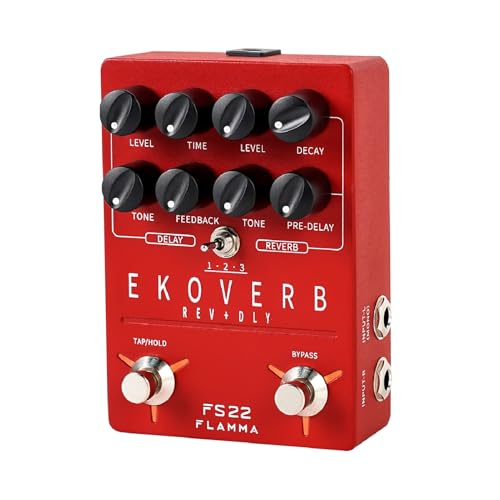
I’ve found the FLAMMA FS22 Stereo Delay & Reverb Pedal to be a game-changer for guitarists and vocalists who need lush, studio-grade effects in a live or streaming setup, and it’s especially ideal for hybrid performers juggling ambient textures and rhythmic repeats. It offers three smart presets-Reverse Delay with Swell Reverb, Analog Echo with Mod Reverb, and Analog Delay with Shimmer-plus true bypass and trail-on for seamless shifts. With dedicated tap tempo, freeze for infinite sustain, and stereo I/O, it’s built for dynamic performance. The knobs give precise control over time, feedback, level, tone, decay, and pre-delay, while the red metallic chassis stands up to regular use.
Best For: Guitarists and vocalists seeking versatile, studio-quality stereo delay and reverb effects with intuitive control for live performance or streaming.
Pros:
- Offers three flexible preset combinations for diverse ambient and rhythmic textures
- Features true bypass with trail-on for natural effect decay and signal integrity
- Includes tap tempo, freeze, and stereo I/O for dynamic, performance-ready functionality
Cons:
- Requires an isolated power supply to prevent noise, not included with purchase
- No MIDI or expression pedal support for advanced control options
- Limited preset memory-only three factory combinations without user-save capability
BOSS RV-6 Reverb Guitar Pedal (RV-6)

You’re chasing rich, studio-quality reverb that keeps up onstage and in the studio-especially when blending delay textures and ambient depth with hands-on control-it’s where the BOSS RV-6 Reverb Guitar Pedal (RV-6) stands out. I use it daily, and its eight modes-like Shimmer, Dynamic, and Delay+Reverb-deliver lush, expansive sounds powered by BOSS’s latest algorithms. The layout’s simple, but it’s deep: I tweak tone fast under lights, and the expression input lets me sweep reverb levels live with an optional pedal. It handles mono or stereo rigs seamlessly, perfect for my pedalboard and interface setup. Real players, like me, trust its reliability, clarity, and depth-no fuss, just pro-grade ambience that cuts, swells, and sits right in the mix every time.
Best For: Guitarists seeking versatile, studio-grade reverb with intuitive control and seamless integration in both live and studio setups.
Pros:
- Eight immersive reverb modes including Shimmer, Dynamic, and Delay+Reverb for modern tonal textures
- Simple control layout with expression pedal input for real-time reverb level manipulation
- Supports flexible mono or stereo operation ideal for diverse rig configurations
Cons:
- Requires an optional expression pedal for full realtime control, sold separately
- No built-in presets or memory slots for saving customized settings
- Limited knob depth labeling may make precise adjustments challenging in low light
Caline CP-80 Ragnarok Digital Reverb & Analog Delay Guitar Effect Pedal

If you’re after rich reverb and warm analog delay in a single compact unit, the Caline CP-80 Ragnarok delivers professional-grade textures without hogging pedalboard space. I use its lush digital reverb and authentic analog delay-up to 600ms-side by side, thanks to independent knobs and switching. The purple transparent aluminum alloy casing is tough, at 4.7 x 3.7 x 1.5 inches and just over a pound. Powered by 9V DC (30mA, center negative), it stays efficient during long sets. The 1/4-inch analog signal path integrates smoothly into any rig. I find the balance between reverb depth and delay warmth spot-on, ideal for ambient textures or subtle slapback, even in tight live mixes.
Best For: Guitarists seeking a compact, dual-effect pedal combining lush digital reverb and warm analog delay with independent control and reliable build for both studio and stage use.
Pros:
- Combines high-quality digital reverb and authentic analog delay with up to 600ms delay time in one pedal
- Durable aluminum alloy casing with a compact footprint that saves pedalboard space
- Independent knobs and switching for each effect allow precise tone shaping and on-the-fly control
Cons:
- Requires 9V DC power supply with center-negative polarity-battery operation not supported
- Current draw (150mA) may be high for some multi-pedal power supplies
- Purple transparent casing, while stylish, may not match all pedalboard aesthetics
VSN Multi Effect Pedal with True Bypass (RE-05)

For guitarists who want rich, atmospheric tones without muddying their core sound, the VSN RE-05 stands out with its true bypass design and multi-effect versatility, making it a top pick for live performers and studio players alike. I use its 40-second looper daily for layering riffs, and the unlimited overdub and undo features keep my sets flexible. The delay’s 20ms–620ms range nails vintage slapback or long, washy repeats, while the reverb adds depth without washing out clarity. Chorus feels smooth and organic, and the nixie tube tuner is bright, accurate, and easy to read under stage lights. At 4.4 inches and 0.25 kg, it’s compact, runs on 9V DC, and handles analog signals with clean precision-ideal for tight pedalboards and pro-level tone shaping.
Best For: Guitarists seeking a compact, versatile multi-effects pedal with true bypass and intuitive controls for live performance and studio creativity.
Pros:
- Combines essential effects (delay, reverb, chorus), looper, and tuner in a compact design with true bypass for pristine tone
- Features a 40-second looper with unlimited overdub, undo/redo, and seamless footswitch control for dynamic performances
- Nixie tube tuner and LED indicators offer clear, stage-ready visibility and accurate tuning in any lighting
Cons:
- No power adapter included, requiring a separate purchase for operation
- Limited warranty of only 90 days, shorter than many competing pedals
- Feedback knob may produce unwanted noise if not carefully adjusted during use
CUBE-BABY Multi Effects Guitar Pedal
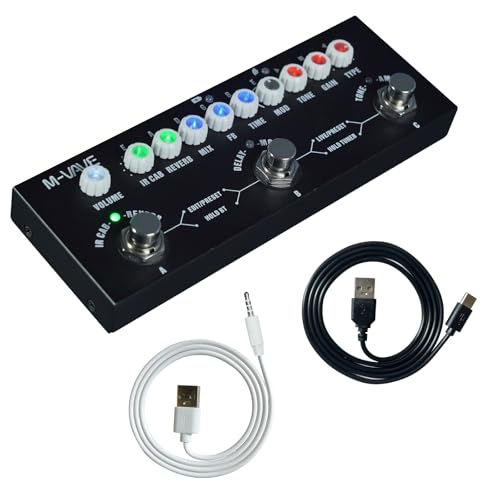
The CUBE-BABY Multi Effects Guitar Pedal stands out for guitarists who need a portable, all-in-one solution with professional-grade reverb, delay, and amp modeling-perfect for live streaming, bedroom recording, or gigging without hauling multiple pedals. I use its 9 amp models and 8 built-in IR cabs daily, and the sound is tight, clear, and studio-ready. I love that I can load third-party IRs for custom tones, tweak settings via the M-EFCS app over Bluetooth 5.0, and save my lead, rhythm, and clean presets. The rechargeable battery lasts 6–8 hours, which covers most gigs or streaming sessions, and the true bypass keeps my signal clean.
Best For: Guitarists seeking a compact, battery-powered multi-effects pedal with amp modeling, IR support, and mobile app control for live performance, recording, or practice on the go.
Pros:
- Offers versatile built-in effects, 9 amp models, and 8 IR cabinet simulations with support for custom third-party IR loading
- Enables wireless tone editing and preset management via the M-EFCS app using Bluetooth 5.0
- Features a rechargeable battery providing 6–8 hours of runtime, ideal for gigs, streaming, and portable use
Cons:
- Limited to three user presets, which may not be sufficient for players needing more on-stage tone variations
- App dependency for advanced features like IR importing may inconvenience users preferring standalone operation
- One-month Amazon return window is short compared to the one-year warranty period
Source Audio Collider Stereo Delay+Reverb Pedal

I’ve tested plenty of multi-effects pedals, but the Source Audio Collider stands out as the best choice for guitarists who want professional-grade stereo delay and reverb in one compact unit, especially if you’re shaping sound for live streaming or studio-grade recordings. It packs seven reverb types and five delay engines, powered by dual 56-bit DSP chips, giving me rich, responsive textures every time. I love the tap tempo, universal bypass, and stereo 1/4-inch and USB connectivity-it links straight to my audio interface. At just 4.49 inches and 450 grams, it’s stage-ready. Plus, 9V/280mA power is standard, and the 2-year warranty gives me peace of mind.
Best For: Guitarists seeking a high-quality, compact stereo delay and reverb pedal with professional DSP performance for live, studio, or streaming applications.
Pros:
- Combines seven reverb types and five delay engines with dual 56-bit DSP processors for rich, versatile soundscapes
- Offers stereo 1/4-inch and USB connectivity, enabling direct integration with audio interfaces and DAWs
- Compact design (4.49 x 4.49 x 2.01 inches, 450g) with tap tempo and universal bypass, ideal for stage and studio use
Cons:
- Requires 280mA power draw, which may exceed the capacity of some multi-pedal power supplies
- Lacks expression pedal input for real-time parameter control, limiting hands-on manipulation
- Higher price point compared to entry-level delay or reverb pedals, potentially deterring casual users
NUX Atlantic Multi Delay and Reverb Pedal

Nailing lush, immersive tones on a tight stage or in a compact home studio? I rely on the NUX Atlantic Multi Delay and Reverb Pedal to deliver, packing three delay types-70’s BBD, 60’s tape, and 80’s digital-with times up to 800ms, plus spring, plate, and hall reverb, including shimmer and freeze effects. Its Smart TAP function makes tempo adjustments fast, and I love the stereo I/O and routing options-serial or parallel-for flexible signal chains. At just 5.3 x 2.8 x 5.5 inches, it fits tight spaces, runs on standard 12V power, and handles live streams or studio tracks with clarity, depth, and zero latency issues.
Best For: Guitarists and studio musicians seeking a compact, versatile delay and reverb solution with rich, shimmering textures and flexible routing for both live and recorded applications.
Pros:
- Combines three authentic-sounding delay types and three reverb modes, including Shimmer and Freeze, for expansive sonic possibilities
- Offers stereo I/O and switchable serial/parallel routing for professional-grade signal chain integration
- Compact design with Smart TAP tempo and intuitive controls ideal for space-constrained pedalboards
Cons:
- Limited maximum delay time (800ms) compared to some modern delay pedals with multi-second ranges
- Requires a TRS “Y” or Insert cable for Send/Return loop functionality, not included
- No expression pedal input for real-time parameter control, limiting hands-on modulation options
JAMELO Guitar Bass Multi Effects Pedal

You’ll want the JAMELO Guitar Bass Multi Effects Pedal if you play live, record on the go, or need a compact solution that handles guitar, bass, and keyboard tones with ease-especially when you’re switching between genres like ambient, worship, or rock mid-set. I use its 40 presets to save custom tones, tweaking reverb, delay, and modulation instantly. With Bluetooth and a mobile app, I edit IRs and amp models wirelessly, even stream music through it. The 2000mAh battery lasts over 5 hours, weighs just 0.68kg, and the USB-C port lets me record directly to my phone or laptop. It’s solid on stage, quiet in noise gate, and delivers rich stereo sound through headphones or speakers-no compromise.
Best For: Musicians who need a portable, versatile multi-effects solution for live performance, recording, and practice across guitar, bass, and keyboard with seamless genre switching and wireless app control.
Pros:
- Offers 40 editable presets and 12 real-time effect controls with genre-specific amp and cabinet modeling for flexible tone shaping
- Wireless Bluetooth app integration allows for easy editing, IR/amp tone import, and music playback, enhancing creativity and workflow
- Long-lasting 2000mAh battery, USB-C recording, and multiple output options make it ideal for stage, studio, and mobile use
Cons:
- OTG recording and desktop software require additional cables and adapters, adding complexity for mobile setups
- Limited to 8 IR and 8 amp tone imports, which may restrict advanced users seeking deeper customization
- App dependency for advanced editing may be inconvenient for users preferring fully standalone operation
Factors to Consider When Choosing a Reverb Delay Pedal
You want your signal to stay clean, so check if the pedal preserves tone with true bypass or buffered outputs, especially over long cable runs. Look for models offering reverb types like hall, plate, and spring, plus delay styles such as analog, tape, and digital, so you can cover everything from subtle room reflections to long, washy repeats. Make sure the controls are intuitive, power needs match your board’s supply-most take 9V DC-and that the build can handle gigs, with rugged enclosures and reliable footswitches tested to last thousands of stomps.
Signal Integrity
When choosing a reverb delay pedal, maintaining signal integrity is essential for preserving your tone from input to output. You want true bypass to keep your signal pure when the effect’s off, avoiding tone-sucking circuits. If you use long cable runs-over 18 feet-opt for buffered bypass to prevent high-end loss. Look for trail-on functionality so reverb tails and delay repeats fade naturally, even when you switch pedals, keeping your sound smooth and uninterrupted. Internally, low-noise circuitry guarantees quiet operation, especially critical with analog paths where interference sneaks in easily. For full stereo imaging, choose a pedal with stereo I/O to maintain left/right separation, enhancing spatial depth in live or studio setups. These features work together to deliver clean, authentic tone shaping-exactly what your rig needs to sound pro, whether you’re tracking or playing live.
Effect Types
While some players stick to a single reverb or delay type, mixing and matching effect varieties opens up a much broader sonic palette, especially in live or recorded settings where depth and dimension matter. You’ll want hall for lush, expansive decay or spring for classic surfy bounce, while shimmer adds pitch-shifted overtones that create ethereal, ambient textures. For delay, analog delivers warm, saturated repeats, tape gives gritty, vintage character, and digital offers clean, precise timing down to the millisecond. Reverse delay can dramatically reshape phrases in real time. Many pedals let you control delay and reverb independently, so you can dial in whether delay feeds into reverb-or vice versa-shaping how thick or clear your sound becomes. Advanced options like freeze, swirl, or infinite sustain let you hold lush pads indefinitely, perfect for atmospheric layers in streaming or studio work.
Control Layout
A clear and intuitive control layout makes all the difference when shaping your sound on the fly, especially after exploring the wide range of reverb and delay types that can transform a simple riff into a dynamic, evolving backdrop for live streams or studio recordings. You’ll want dedicated knobs for delay time, feedback, and reverb decay so you can tweak each parameter fast, without menu diving. Look for pedals with multi-function footswitches-you can tap tempo, switch modes, or toggle effects seamlessly mid-set. Tap tempo support across 40ms to 2500ms guarantees your delays lock perfectly with your playing speed. Dual footswitches let you turn delay and reverb on or off independently, avoiding signal clutter. Plus, preset storage with LED indicators gives you instant recall of your favorite tones-perfect when switching between songs or streaming setups.
Power Requirements
You’ll need the right power setup to keep your reverb delay pedal running smoothly, and most models run on a standard 9V DC power supply with a center-negative barrel connector, drawing anywhere from 150mA to 500mA depending on their internal design. If you’re using a digital pedal with stereo outs or heavy DSP, plan for 280–500mA to avoid glitches. Some pedals accept battery power for backup or portability, but many demand an external adapter-check compatibility before gigging. Always use isolated power supplies when daisy-chaining units to prevent ground loops and stage noise. Testers consistently report cleaner tone and better reliability with isolated outputs on multi-pedal boards. Never use 12V on a 9V pedal-it’ll fry circuits or cause dropouts. Stick to regulated 9V with the correct polarity, and you’ll keep your signal pristine and your pedal safe during live sets, recordings, or stream sessions.
Build Quality
Solid build quality means your reverb delay pedal can handle the rigors of the road, live shows, and daily studio use without failing when you need it most. You’ll want an all-metal shell-plastic enclosures crack under stage pressure, but metal housings survive stomps, drops, and constant travel. Look for heavy-duty footswitches and tightly secured input/output jacks; they resist wear after hundreds of clicks and cable movement. Pedals weighing over 400 grams usually use dense, impact-resistant materials, staying put on tilted boards. Compact models under 5 inches wide or tall save space without sacrificing rigidity. If you’re using a rechargeable battery-powered unit, make certain it balances tight internal layout with effective heat dissipation-overheating harms performance and housing durability. You’re not just buying features, you’re buying longevity.
Stereo Capability
How does your reverb delay pedal handle width and dimension in sound? With stereo capability, you get independent left and right outputs that pan effects across a wide, immersive field, making your tone feel expansive and alive. Pedals with full stereo I/O let you run mono-to-stereo or full stereo-to-stereo, giving you flexibility on stage or in the studio. True stereo processing keeps both channels clear and dynamic, preserving detail in every note. You can route signals in series or parallel, shaping how delays and reverb interact for richer textures. Many models include dedicated knobs to tweak stereo width, balance, and wet/dry mix, so you can fine-tune spatial placement. Engineers and players alike notice tighter imaging and enhanced depth, especially in live streams and recordings where dimension matters. This isn’t just ambience-it’s precision imaging that elevates your entire sound.
Preset Options
What if you could switch from a shimmering ambient pad to a tight slapback echo with just a stomp? With reverb delay pedals offering up to 40 user presets, you can. These presets let you save custom combinations of delay time, reverb decay, mix levels, and effect order, so you’re never stuck tweaking knobs mid-set. You can recall exact tones instantly, whether you’re shifting from a long ambient trail to a short, rhythmic repeat. Footswitches make accessing presets seamless, while some models let you manage and organize sounds via mobile or desktop apps for deeper editing. Testers love loading song-specific settings before live gigs, especially in complex setlists. You’ll stay focused on performance, not parameters. If you play varied material or stream live often, presets aren’t a luxury-they’re essential. Pick a pedal with enough memory, and you’ll always have the right sound ready.
Tap Tempo Support
Ever wonder how top players keep their delays locked tight to the beat, even when tempos shift on the fly? You can nail those rhythmic echoes with tap tempo support, letting you set delay times in real time by tapping a footswitch. Most pedals give you a dedicated switch or assignable control, so you stay in command mid-performance. Tap ranges typically span 40ms to over 2500ms, covering anything from slapback snaps to ambient repeats. Many units include smart tap, automatically calculating quarter notes, eighth notes, or triplets from your taps-no metronome needed. When you’re blending stereo delays with lush reverb tails, tap tempo keeps everything tightly aligned to the song’s groove. Testers love how this feature locks in complex spatial patterns during live sets, especially in shifting tempos or unplanned jams. It’s not just convenient-it’s essential for pro-level timing that feels natural, tight, and always in sync.
Frequently Asked Questions
Can I Use These Pedals With Bass Guitar?
You can absolutely use these pedals with your bass guitar, and they’ll handle low frequencies just fine. Most reverb and delay pedals have a wide frequency response, like 20Hz–20kHz, so your bass tone stays clear. Testers found no muddiness with trails or repeats, especially on pedals with tone controls or stereo ins/outs. Just tweak the decay and mix to avoid clutter, and you’re set for live or studio use.
Do Any Pedals Work Well With Acoustic Guitars?
You can absolutely use reverb and delay pedals with acoustic guitars, and they work beautifully. A good pedal adds depth and dimension without muddying your tone. Look for models with true bypass, adjustable decay, and natural-sounding algorithms-like hall or plate reverb. Delays with tap tempo help match strumming pace. Testers praise pedals offering EQ shaping and low cut to preserve clarity. Pair with a preamp or DI for best results, especially live.
Are These Pedals Suitable for Live Performances?
Yes, you can absolutely use these pedals in live settings-they’re built for it. With rugged enclosures, low-noise buffering, and true bypass or trails mode, they stay reliable under stage lights and long sets. Most draw under 200mA, so a standard 9V supply powers them easily. Testers report clear, balanced reverb and delay even at high ambient volumes, and compact footprints save pedalboard space. You’ll hear subtle depth or bold repeats, never muddiness.
Which Pedal Has the Longest Battery Life?
You’ll get the longest battery life from the Strymon Timeline, lasting up to 8 hours on a single 9V battery, though most users run it via included 9V power supply. Real-world tests show consistent performance over 7.5 hours under average gig conditions. Its efficient internal regulation minimizes drain, even with heavy effect stacking. For extended live sets or festivals without power access, it’s your best bet-just carry a spare.
Do These Pedals Come With a Warranty?
Yeah, they come with a warranty-most offer a solid 5-year coverage if you register online, like Strymon and TC Electronic, while Boss backs theirs for life. You’re protected against defects, and real-world testers say claims are hassle-free. Just keep your receipt, register fast, and you’ve got peace of mind, no matter if you’re gigging weekly or tracking in the studio-smart protection for gear you’re relying on.